
Justin Larrabee



Justin Larrabee
For option 2, it's almost as if a masked tile is a wildcard right?
Yea, the RotatedTile thing bit me a bit at first as I was using the API. I feed RotatedTiles directly into the AddSample calls since my input tilemaps are using...
So in this example the collection of tiles in the bottom left are my "corpus". I use that tilemap to define adjacency pairs and valid placements. 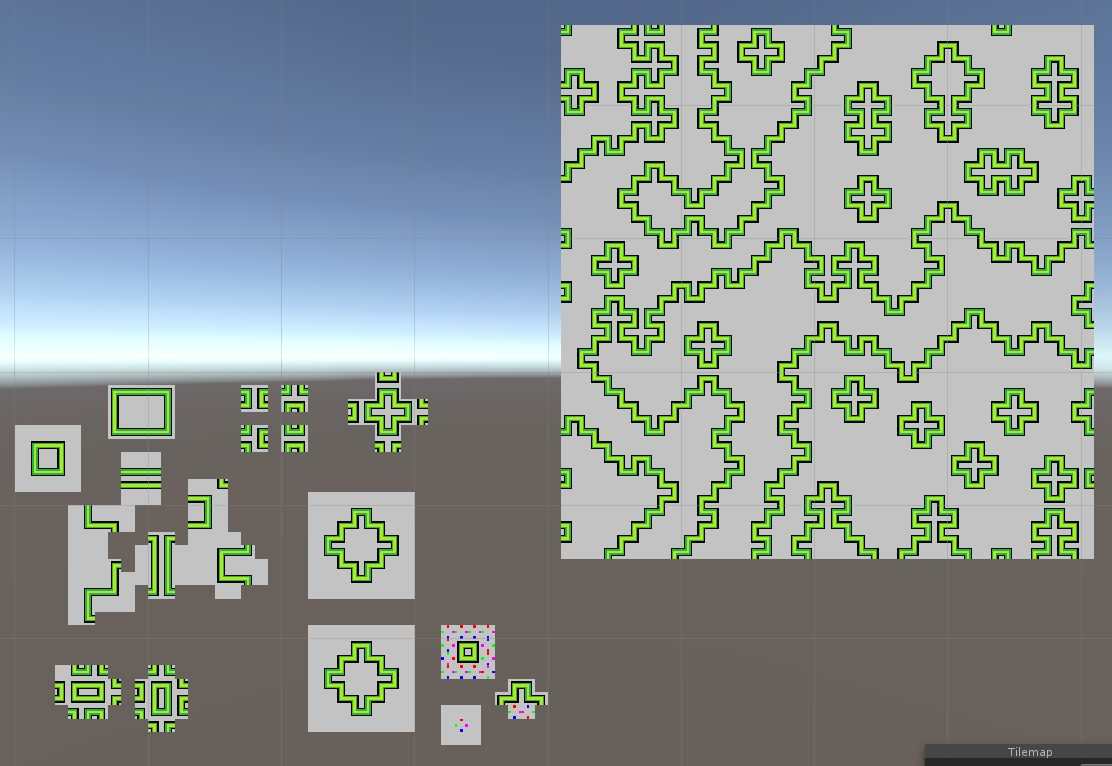 And in my...
NormalizeFrequencies(false), yes frequency[x] = x/n where n == totalFrequency. For the NormalizeFrequency(true) case, the goal is the same but a tile and its rotations all "share" their chunk of x/n...
So if you did that the psuedocode equivalent for me would be (?): foreach (tile) { model.SetFrequency(tile, 1, includeRotations:true); } model.NormalizeWeights()
Ah yea got it, the actual value of `frequency` doesn't matter as long as every tile has the same value. When I think "normalized" I am biased towards [0,1].
I'll give MultiplyFrequency a shot with some special tiles. Being able to force Select into setting a tile might be a good quick way to accomplish this. Combined with #2,...
Worth noting I had to use 1.38.1 to get this to work on WSL1 + Unity.
See PR https://github.com/Flafla2/Vive-Teleporter/pull/14
@lostghost Yea, the solution I have seen in other libraries is to simply export a "DefaultClient" variable that the user of the library can simply override. Alternatively you could export...