
drjdpowell
drjdpowell

Hello, I am trying to use the re extension for RegEx (on Windows, compiling for 32-bit). Functions all work, except for the regexp_replace function. It returns correctly when it doesn't...
The Client Sync Calls are well set up to eventually support an Async Client API, as they basically have "Start Action" parts, a "Wait till done" part, and a "Read...
In #203 , @gregr-ni wrote: >Our intended workflow is to start with a proto file and generate the client code. Isn't all the code you describe generated in this case?...
 Your examples define the name of Message types in multiple places. Consider always using the Cluster typedef name to get...
Currently, you have a separate User Event (UE) for each gRCP call type. This requires a lot of extra "boilerplate" to set up each UE, as shown in this image:...
Many advanced users will want to adapt gRPC into the Framework or templates they already have, using the lower-level functions, rather than use the higher-level architecture and scripting tools. So...
Attached is a ZIP of a Project containing the pictured example. Includes a small class, "gRPC Definition", that allows defining a Procedure and its Request/Response Messages in one place. This...
Having a look at this gRPC work for the first time, I am struck by the large number of subVI's with similar names. Looking at handling a HelloWord gRPC call,...
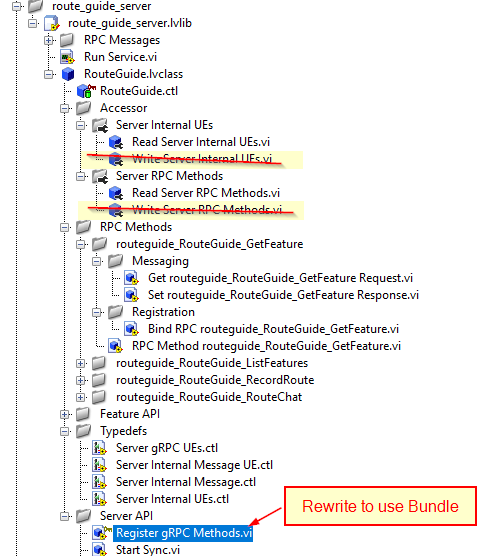 UEs should be written in only one place: "Register gRPC Methods.vi", so don't have the ability to write to them elsewhere. Otherwise, this is...
For a stream of client requests, such as the "RecordRoute" example, the server event loop is blocked during teh (potentially very long) interaction. Users may prefer an alternate asynchronous mode,...