vgrem
vgrem
Client object breaks trying to call method
Hi all! Working with onedrive API I found out that, once I instantiate the client = GraphClient(acquire_token_func(tenant_id, client_id, client_secret)):
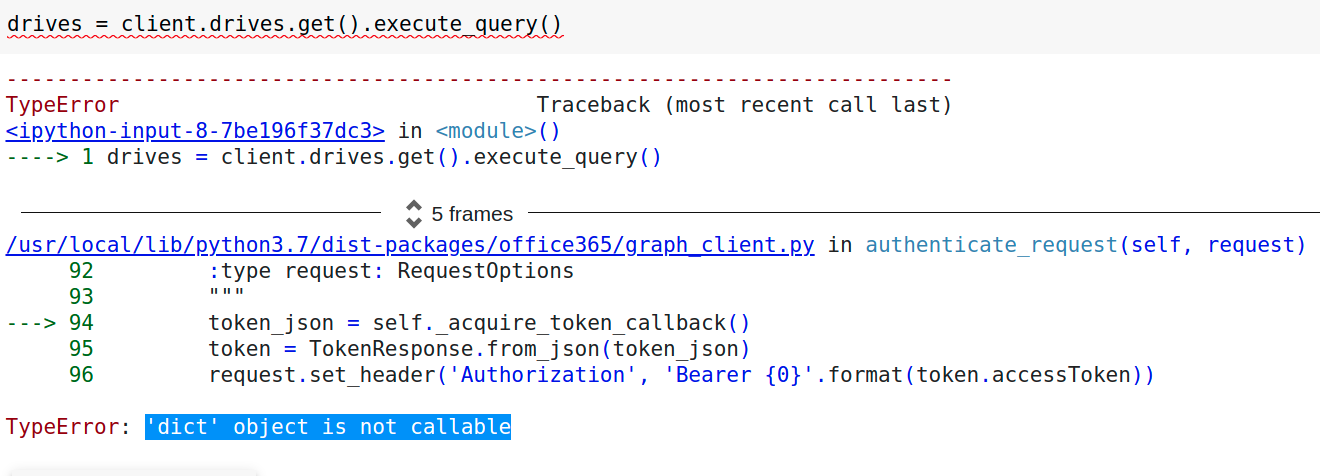
I think that the error happens here https://github.com/vgrem/Office365-REST-Python-Client/blob/master/office365/graph_client.py#L94
... because the _acquire_token_callback() shouldn't be called as a method. At least, when I explore this:
client._acquire_token_callback['access_token']
the access token shows up correctly (which make me infer that client id, secret and tenant are good

Greetings!
GraphClient class constructor accept a callback function as an input argument, for example:
client = GraphClient(acquire_token_by_client_credentials)
where
def acquire_token_by_client_credentials():
    authority_url = 'https://login.microsoftonline.com/{0}'.format(tenant_name)
    app = msal.ConfidentialClientApplication(
        authority=authority_url,
        client_id=client_id,
        client_credential=client_secret
    )
    return app.acquire_token_for_client(scopes=["https://graph.microsoft.com/.default"])
The callback function is expected to return a dict representing the json token (which should contain access_token key):
{
   'token_type': 'Bearer',
   'scope': 'profile openid email https://graph.microsoft.com/Mail.Send',
   'access_token': '--access token goes here--',
}
By default Microsoft Authentication Library (MSAL) for Python library is utilized to acquire tokens.
And finally, callback function gets invoked during authenticate_request call by library.

@vgrem thanks for the explanation! The client object I'm showing in the first post was instantiated in the same way you do. I mean, by calling the acquire_token_by_client_credentials method with my tenant, client id and secret.
When I try to call drive items from the client object, like this
drives = client.drives.get().execute_query()
... then the error I showed in the post raises up.
I manage to get my token if I do the following:
client._acquire_token_callback
This returns me something like:
{'access_token': 'my_token',
 'expires_in': 86399,
 'ext_expires_in': 86399,
 'token_type': 'Bearer'}
In the description, the error shows that method breaks when trying to call the callback function. But if I try it out of the client.drives.get() (like I showed you above) it works fine:

To sum up, in my case this is breaking in line 94 of the graph_client.py when trying to do token_json = self._acquire_token_callback(). That's why I'm asking if it should be _acquire_token_callback instead.
I'm not managing to instantiate the drives object to call the .web_url attribute
Hi PyMap,
I have started working with vgrem's package only yesterday and following his examples worked fine for me. But then I restructured and integrated the code in my existing code - and accidentally initiated the client instances by calling the acquire_token_func using "() "at the end: client = GraphClient(acquire_token_func()) - this produced exactly the error you are describing here also for me... did you iniate the client perhaps also with "()"

The callback function needs to return an instance of office365.runtime.auth.token_response.TokenResponse not a dict.
    token = app.acquire_token_for_client(scopes=["https://graph.microsoft.com/.default"])
    return TokenResponse(**token)
works for me.