
bambleweeny
 bambleweeny copied to clipboard
 u1i
u1i
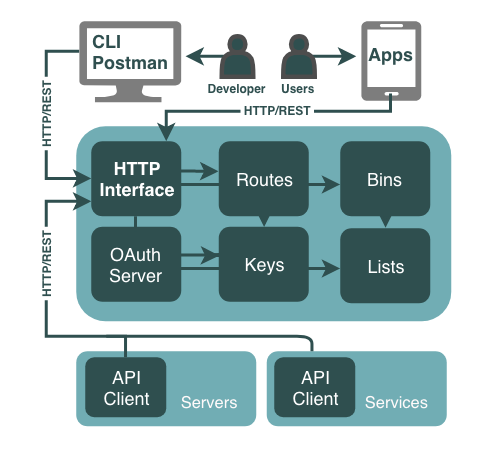
Bambleweeny is lightweight key-value store and message broker based on HTTP/REST.







Bambleweeny is a lightweight HTTP/REST based key-value store and message broker that offers identity, access & quota management. It's fast, easy to use, and well-documented.
Written in Python, using a Redis backend, deployable in a tiny container.
Use cases: NoSQL database, web cache, data ingestion, quick prototyping, mocking API endpoints, webhooks, configuration management and coordination across distributed systems.
Run Bambleweeny
docker run -d -p 8080:8080 u1ih/bambleweeny
This gives you a single, stateful and self-contained instance. Good enough for demos and tests. See the Documentation Index for infos on how to run it as a topology, in Kubernetes and OpenShift.
Simple HTTP based Key/Value Access
Bambleweeny has a nice command-line interface. Here we'll show you some cURL examples, since everything happens over HTTP:
Get 'foo'
curl http://b9y/keys/foo -H AUTH
Set 'foo' = 'bar'
echo bar | curl -X PUT -d @- http://b9y/keys/foo -H AUTH
Make 'foo' public, so anyone can read
echo '{"key":"foo", "content_type":"text/html"}' | curl -X POST -d @- http://b9y/routes -H AUTH
/routes/125e6a6f-c3f3-403b-b096-89978773139b
curl http://b9y/routes/125e6a6f-c3f3-403b-b096-89978773139b
bar
Upload binary files
curl --upload-file image.png http://b9y/keys/pic -H AUTH
Create a counter - 'pick a number'
curl http://b9y/incr/ticket_number -H AUTH
Message Broker
Push a message to a queue
echo test_message | curl -X POST http://b9y/lists/my_queue -H AUTH
Pop a message from a queue
curl http://b9y/lists/my_queue -H AUTH
The Getting Started Guide helps you get going quickly.
Using the REST API
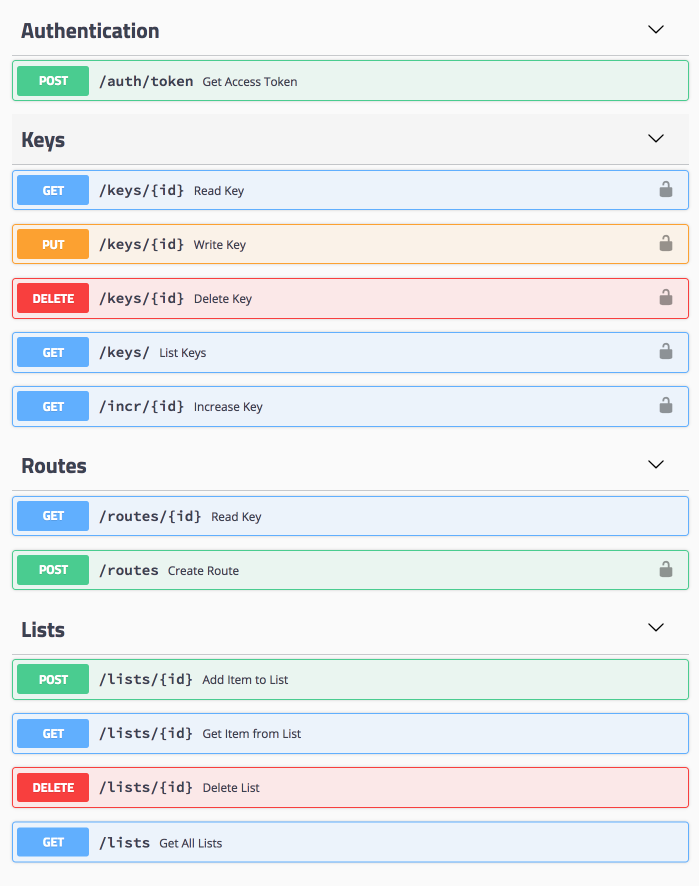
The endpoint /swagger gives you the Swagger file. Check out the Getting Started Guide and the API Documentation for detailed information on managing users, keys and lists.
Performance (Apache Bench)
- ~45 reads per second, ~29 writes per second - Raspberry Pi 3 Model B, ARMv7 1GB RAM
- ~540 reads per second, ~400 writes per second - 1x vCPU 1 GB RAM (AWS t2.micro)
- ~800 reads per second, ~530 writes per second - MacBook Pro 2.9GHz i7 16GB RAM
Behind the Scenes
Design Principles:
- minimal use of external libraries
- readable code over performance
- simplicity over feature overload
 u1i
u1i