
testify

testify copied to clipboard
 stretchr
Colorize 'expected' and 'actual'
Summary
Colorize "expected" and "actual"
Changes
Resolves #946
Motivation
-
@boyan-soubachov says "It's an interesting idea."
-
@mvdkleijn says "I like this idea."
package testify

import (
	"errors"
	"testing"

	"github.com/stretchr/testify/assert"
)

func TestExamples(t *testing.T) {
	wrapT := assert.WrapColorize(t)
	newAssert := assert.New(wrapT)

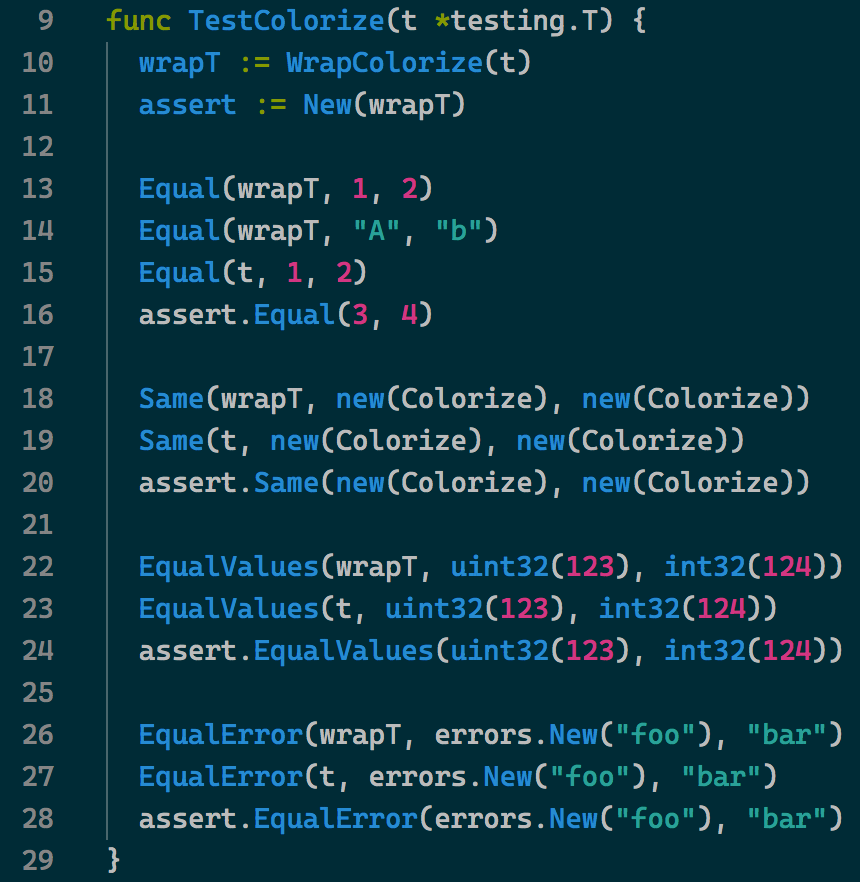
	assert.Equal(wrapT, 1, 2)
	assert.Equal(wrapT, "A", "b")
	newAssert.Equal(3, 4)

	assert.Same(wrapT, new(assert.Colorize), new(assert.Colorize))
	newAssert.Same(new(assert.Colorize), new(assert.Colorize))

	assert.EqualValues(wrapT, uint32(123), int32(124))
	newAssert.EqualValues(uint32(123), int32(124))

	assert.EqualError(wrapT, errors.New("foo"), "bar")
	newAssert.EqualError(errors.New("foo"), "bar")
}
Related issues
N/A
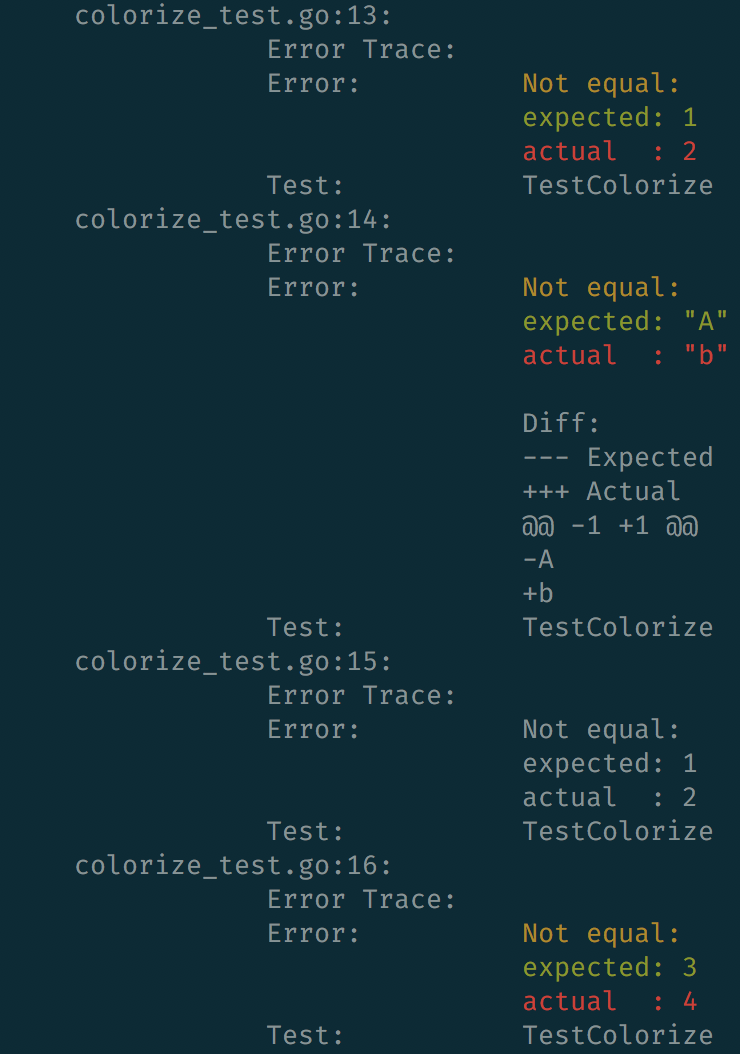
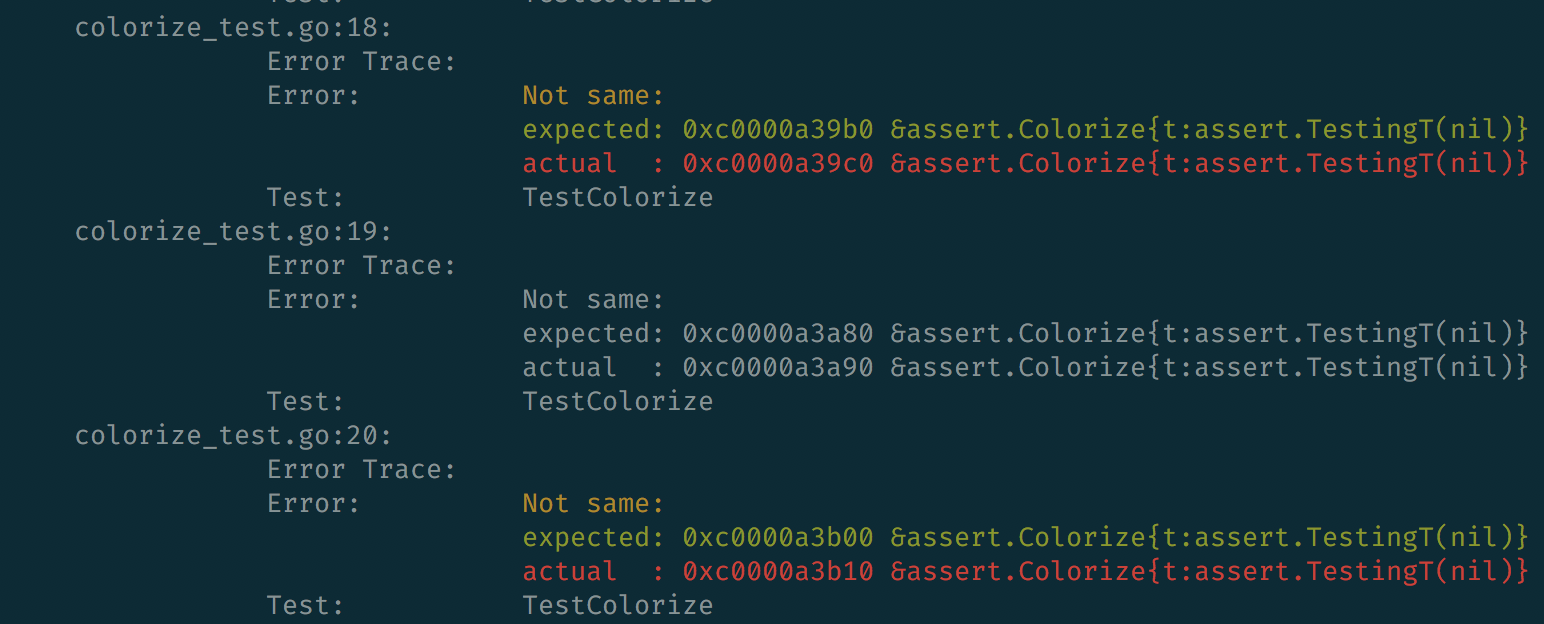
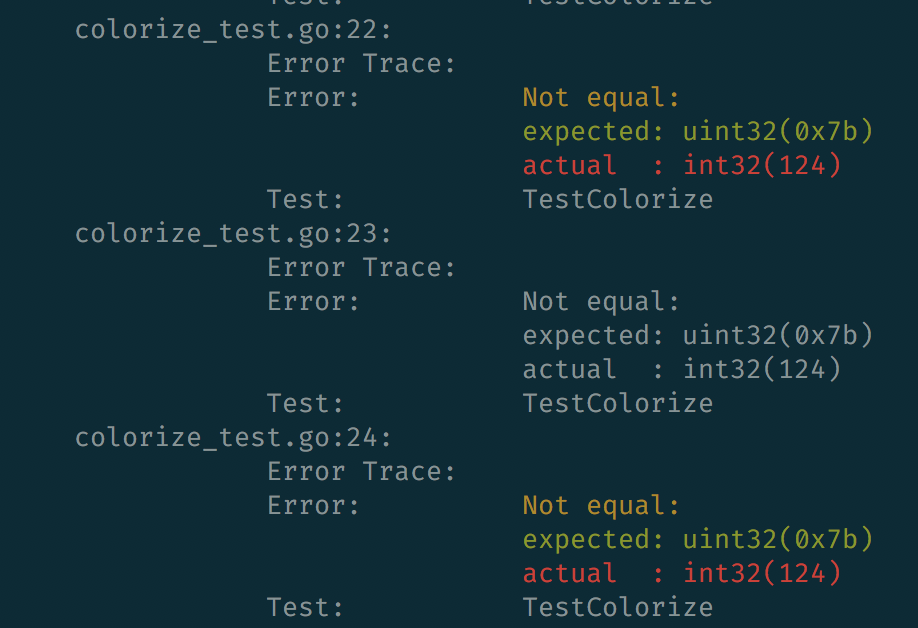
Screenshot
TestColorize
Equal
Same
EqualValues
EqualError
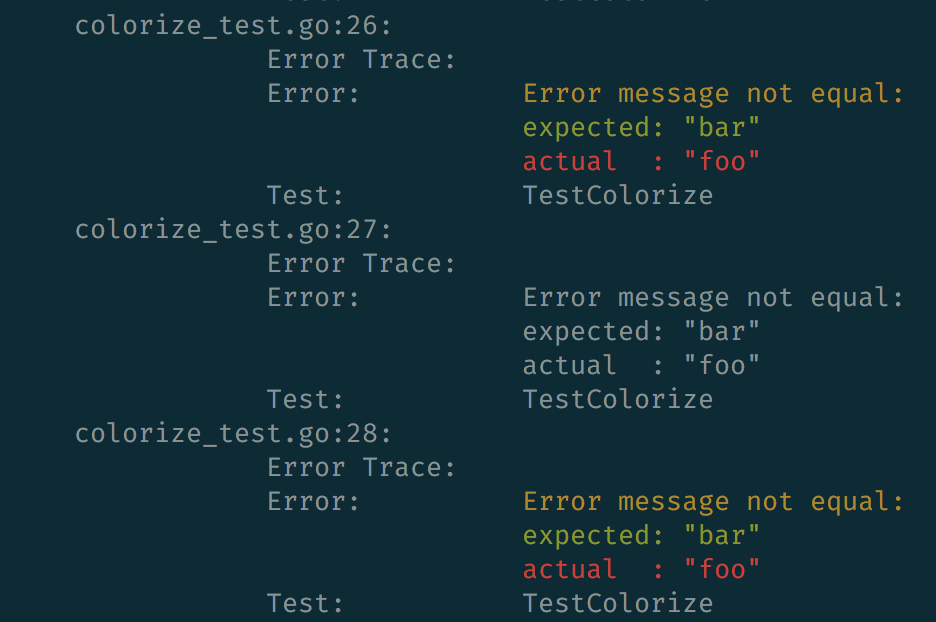

Dear @boyan-soubachov , do you mind review this PR or give some suggestion?
Can you retest by redirecting to a file and see if you see control characters ?

I think yes.
Please refer this unit test: assert/colorize_test.go#L31
func TestColorize_Message(t *testing.T) {
	failureMessage := fmt.Sprintf("Not equal: \n"+
		"expected: %s\n"+
		"actual  : %s%s", "expected", "actual", "diff")
	fmt.Println(WrapColorize(t).Message(failureMessage))
}
output:

I think yes.
Please refer this unit test: assert/colorize_test.go#L31
func TestColorize_Message(t *testing.T) {
	failureMessage := fmt.Sprintf("Not equal: \n"+
		"expected: %s\n"+
		"actual  : %s%s", "expected", "actual", "diff")
	fmt.Println(WrapColorize(t).Message(failureMessage))
}
output:
I think that proves it fails - you can see the terminal escapes e.g. [31m and [0m.