
ESP32-Generic
 ESP32-Generic copied to clipboard
 revk
revk
Simple generic ESP32 based PCB design, ideally suited to battery use.
ESP32-Generic
Software and hardware for generic ESP32 usage. Software based on ESP32-RevK library.
The software is all sorts of mish mash of stuff, mainly to demo things. Can work with an e-paper display to show messages. Has simple input reporting and output with pulses and counts, etc. Can even work DEFCON lights mode, or debug dump serial data each way to a Daikin air-con controller. Basically it ends up with any little project that I don't think deserves its own project yet.
Building
Git clone this --recursive to get all the submodules, and it should build with just make. That actually runs the normal idf.py to build. make menuconfig can be used to fine tune the settings, but the defaults should be mostly sane. make flash should work to program.
Hardware
Various KiCad designs, with 3D printed case designs.
Generic S3 board
- USB-C flash/debug/power
- DC 5V-17V
- All GPIOs
- WS2812 on GPIO 0

ESP01 Style ESP32 board
- Even smaller than ESP01 (13.2mm x 23.4mm including antenna)
- Same pin out (though RST is just a GPIO on this)
- No USB or voltage regulator - works from 3.3V and needs programming via Tx/Rx/GPIO0 pins, just like ESP01

ESP32-Generic
- Very small size (29mm x 19mm PCB, plus antenna)
- ESP32-WROOM-32 design
- 6 pin connector (SPOX 2.5mm or 0.1"), which are GND and 5xGPIO
- Pads to allow linking one pin to DC supply (and not linking to GPIO)
- Pads to allow linking other pins to 3.3V, e.g. pull ups, or to power somethign external
- Pad to allow linking one pin to GND, e.g. capacitor
- USB-C connection for power and also debug/serial.
- Alternative external DC supply 4V to 60V (safe to connect at same time as USB-C)
- On board RGB LED.

ESP32-Generic2
- Larger PCB (35.5mm x 22.5mm, plus antenna)
- ESP32-WROOM-32 design
- Two 8 pin connectors (SPOX 2.5mm or 0.1"), which are all connected to GPIO
- Pad (pre-bridged) linking one pin on each side to GND, can be cut
- Pad allowing one pin to link to DC supply (need to cut the series pad to disconnect from GPIO)
- Pad allowing one pin to link to 3.3V, e.g. pull up, or to power somethign external

ESP32-Generic3
- Larger PCB (35mm x 21.5mm, plus antenna)
- ESP32-PICO-MINI based design
- 2 pin connector for DC (SPOX 2.5mm or 0.1")
- 10 pin GPIO connector (SPOX 2.5mm or 0.1")
- Pads to allow a GPIO to be tied to GND and one to be tied to 3.3V to power a separate device if needed
- USB-C connection for power and also debug/serial.
- Alternative external DC supply 4V to 60V (safe to connect at same time as USB-C)
- On board RGB LED
- A buzzer connection, as separate pads on back of board, with FET drive and back EMF diode

ESP32-Generic4
General purpose small board for use from DC supply not USB
- Tiny board! (13.2mm x 19.5mm, plus antenna)
- Designed to work with simple 4 pin SPOX (GND, DC, 2xGPIO), or additional 0.1" headers making total of 10 GPIO (including GPIO0)
- Note the first 5 0.1" pins are GND, GPIO0, 3.3V, Rx (to module), Tx (from module) so match a Shelly 1, and so can work with Shelly Tasmotizer board.
- DC is 4V to 60V
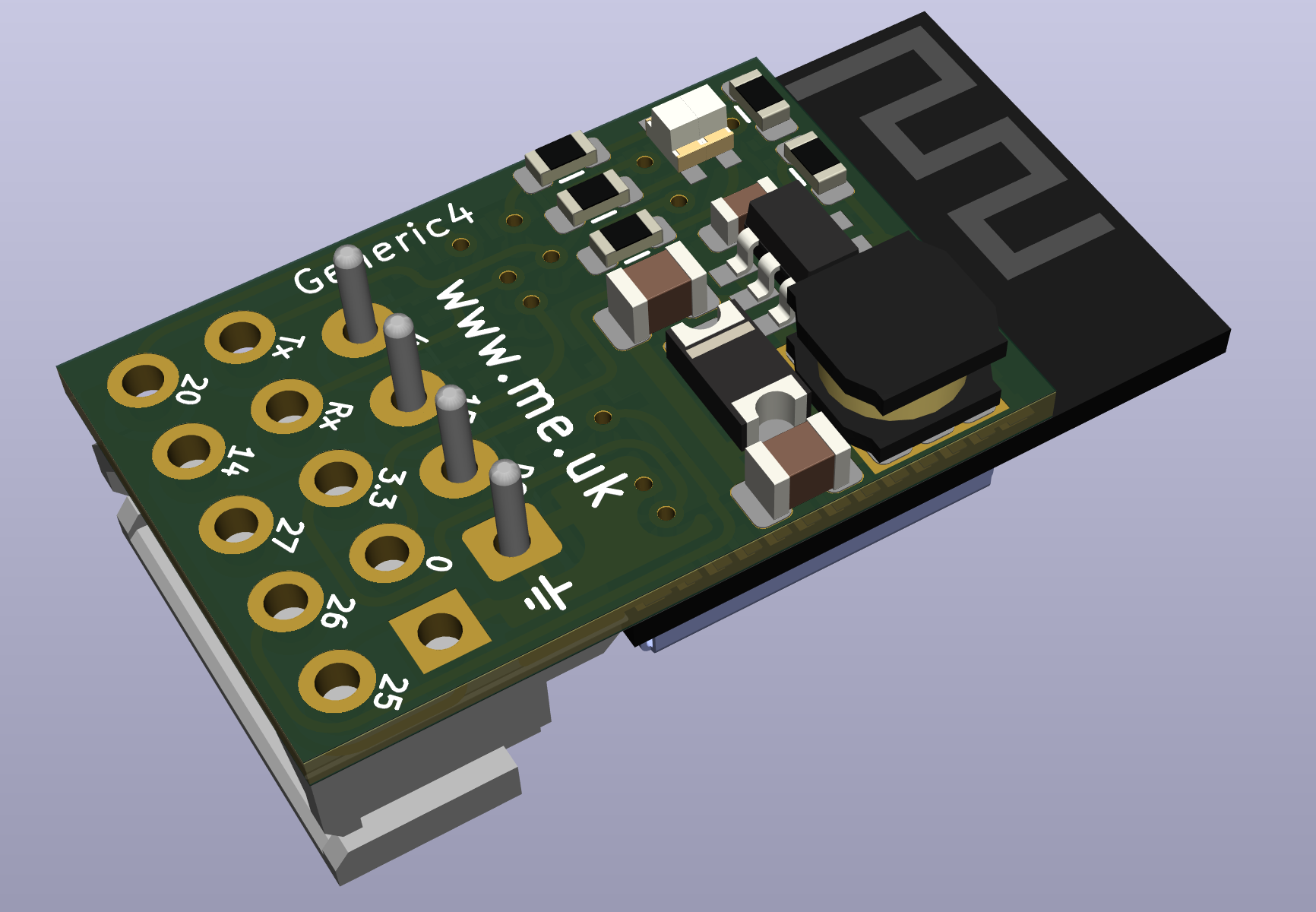
ESP32-Generic5
General purpose small board for use from USB, including passing 5V to connected device (Display, LED strip, etc, etc).
- Tiny board (12.5mm x 21mm, with antenna on side)
- USB connection
- RGb LED
- 4 pin SPOX connector can be all GPIO
- Pin 1 can be linked to GND
- Pin 2 can be unlinked from GPIO and linked to USB 5V supply
- Pin 3 has addition FET on separate GPIO to drive 3.3V supply, and a back EMF diode, allowing drive of buzzer, etc.

ESP32-LowPower
Same as ESP32-Generic but for low power battery working.
- FET switched potential divide for ADC reading battery supply.
- Can work with USB chip disabled (power via DC connector instead)
- Approx 35uA on 9V battery in sleep mode
- USB-C connection for power and also debug/serial.
- Alternative external DC supply 4V to 60V (safe to connect at same time as USB-C)
- On board RGB LED.
ESP32-USBA
Unlike the rest this is a much simpler PCB, PCB designed for direct plug in to USB-A socket.
- RGB LED
- Button

Copyright © 2019-22 Adrian Kennard, Andrews & Arnold Ltd. See LICENCE file for details. GPL 3.0
 revk
revk