

 pymc-devs
ENH: add MarginalGP model and fixes in covariance functions API
- [x] Add
MarginalGPmodel. - [x] Add tests
- [x] Add documentation suite
- [x] Add notebook

I have completed my work on the model and now tests and a notebook is left. Can one of you take a look at this please @fonnesbeck @aloctavodia
All the doctests are passing but I cannot get NUTS to run on this, unfortunately.

Codecov Report
Merging #309 into master will decrease coverage by
0.50%. The diff coverage is83.09%.

@@            Coverage Diff             @@
##           master     #309      +/-   ##
==========================================
- Coverage   90.89%   90.38%   -0.51%
==========================================
  Files          36       36
  Lines        2822     2903      +81
==========================================
+ Hits         2565     2624      +59
- Misses        257      279      +22
| Impacted Files | Coverage Δ | |
|---|---|---|
| pymc4/distributions/multivariate.py | 100.00% <ø> (ø) |
|
| pymc4/gp/_kernel.py | 79.82% <ø> (ø) |
|
| pymc4/gp/gp.py | 79.14% <76.53%> (-6.37%) |
:arrow_down: |
| pymc4/gp/cov.py | 90.33% <97.36%> (+0.54%) |
:arrow_up: |
| pymc4/gp/util.py | 100.00% <100.00%> (ø) |
![codecov[bot] avatar](https://avatars.githubusercontent.com/in/254?v=4 "Published by a pub.dev verified publisher")
What's the issue with NUTS?
@fonnesbeck It is giving me this error no matter what the input is:
Traceback (most recent call last):
  File "<stdin>", line 1, in <module>
  File "C:\Users\tirth\Desktop\INTERESTS\PyMC4\pymc4\inference\sampling.py", line 172, in sample
    results, sample_stats = run_chains(init_state, step_size)
  File "C:\Users\tirth\Desktop\INTERESTS\PyMC4\env\lib\site-packages\tensorflow\python\eager\def_function.py", line 780, in __call__
    result = self._call(*args, **kwds)
  File "C:\Users\tirth\Desktop\INTERESTS\PyMC4\env\lib\site-packages\tensorflow\python\eager\def_function.py", line 846, in _call
    return self._concrete_stateful_fn._filtered_call(canon_args, canon_kwds)  # pylint: disable=protected-access
  File "C:\Users\tirth\Desktop\INTERESTS\PyMC4\env\lib\site-packages\tensorflow\python\eager\function.py", line 1842, in _filtered_call
    return self._call_flat(
  File "C:\Users\tirth\Desktop\INTERESTS\PyMC4\env\lib\site-packages\tensorflow\python\eager\function.py", line 1922, in _call_flat
    return self._build_call_outputs(self._inference_function.call(
  File "C:\Users\tirth\Desktop\INTERESTS\PyMC4\env\lib\site-packages\tensorflow\python\eager\function.py", line 545, in call
    outputs = execute.execute(
  File "C:\Users\tirth\Desktop\INTERESTS\PyMC4\env\lib\site-packages\tensorflow\python\eager\execute.py", line 59, in quick_execute
    tensors = pywrap_tfe.TFE_Py_Execute(ctx._handle, device_name, op_name,
tensorflow.python.framework.errors_impl.InvalidArgumentError:  Input matrix is not invertible.
         [[{{node mcmc_sample_chain/trace_scan/while/body/_171/mcmc_sample_chain/trace_scan/while/smart_for_loop/while/body/_565/mcmc_sample_chain/trace_scan/while/smart_for_loop/while/dual_averaging_step_size_adaptation___init__/_one_step/NoUTurnSampler/.one_step/while/body/_885/mcmc_sample_chain/trace_scan/while/smart_for_loop/while/dual_averaging_step_size_adaptation___init__/_one_step/NoUTurnSampler/.one_step/while/loop_tree_doubling/build_sub_tree/while/body/_1167/mcmc_sample_chain/trace_scan/while/smart_for_loop/while/dual_averaging_step_size_adaptation___init__/_one_step/NoUTurnSampler/.one_step/while/loop_tree_doubling/build_sub_tree/while/loop_build_sub_tree/leapfrog_integrate/while/body/_1449/mcmc_sample_chain/trace_scan/while/smart_for_loop/while/dual_averaging_step_size_adaptation___init__/_one_step/NoUTurnSampler/.one_step/while/loop_tree_doubling/build_sub_tree/while/loop_build_sub_tree/leapfrog_integrate/while/leapfrog_integrate_one_step/maybe_call_fn_and_grads/value_and_gradients/value_and_gradient/gradients/mcmc_sample_chain/trace_scan/while/smart_for_loop/while/dual_averaging_step_size_adaptation___init__/_one_step/NoUTurnSampler/.one_step/while/loop_tree_doubling/build_sub_tree/while/loop_build_sub_tree/leapfrog_integrate/while/leapfrog_integrate_one_step/maybe_call_fn_and_grads/value_and_gradients/value_and_gradient/loop_body/PartitionedCall/pfor/PartitionedCall_grad/PartitionedCall/gradients/Cholesky/pfor/Cholesky_grad/triangular_solve/MatrixTriangularSolve}}]] [Op:__inference_run_chains_27917]
Function call stack:
run_chains
Never seen this before. But I will try to debug it
Turns out this happened due to the choice of poor priors and kernels. I solved it by adding a white noise kernel. So NUTS now works (just have to add a lot of noise for float32 data type which is not very good).
Yeah, the TFP Gaussian processes have default jitter, which can be customized as an argument to the constructor. I wonder if we should do similarly.
I have already added the jitter argument that defaults to 1e-4 for float32 and 1e-6 for float64 datatype and works in a similar way as TFP.
On Sat, Aug 1, 2020, 1:41 AM Chris Fonnesbeck [email protected] wrote:
Yeah, the TFP Gaussian processes have default jitter, which can be customized as an argument to the constructor. I wonder if we should do similarly.
— You are receiving this because you authored the thread. Reply to this email directly, view it on GitHub https://github.com/pymc-devs/pymc4/pull/309#issuecomment-667332749, or unsubscribe https://github.com/notifications/unsubscribe-auth/AKJOJRBDOCU3B6TZ6ULSI3LR6MQQDANCNFSM4PQHBW6Q .
I have added the notebook but the inference is really difficult. Tried both full rank ADVI and NUTS but still not able to get good results. I will play around with it more... meanwhile accepting some reviews on the notebook @AlexAndorra @bwengals (there may be loads of typos since I did this in a hurry. 😅)
I never liked the name MarginalGP as it's not descriptive from the user's perspective. LatentGP is better in this way because it tells me to use this for latent GPs. But what the hell is a marginal GP? How about ObservedGP?

Its because it is based on the marginal likelihood. I'd hesitate to use Observed because it is so closely associated with data in PyMC. You could make an argument for just GP, since it is the canonical form of the Gaussian process.
@fonnesbeck Well I understand that but I don't think it makes sense from a user perspective who doesn't know the underlying math of GPs. Not married to Observed but anything that is more intuitive and doesn't require knowing what a marginal likelihood and why it's being used here.
@twiecki I see your general point regarding hiding unnecessary technical jargon from the user, but here its pretty important that the user does recognize that the marginal likelihood is required, because in the next line they will be calling marginal_likelihood. GPs are slightly more advanced than parametric PyMC3, and part of that is knowing when the marginal likelihood is appropriate and when it is not. We just need to make sure our docs and examples provide this baseline knowledge (and I think they mostly do, but could use a review by a non-expert user).
Running fit fails for me locally:
---------------------------------------------------------------------------
ValueError                                Traceback (most recent call last)
 in
----> 1 advifit = pm.fit(model, method="fullrank_advi")

~/repos/pymc4/pymc4/variational/approximations.py in fit(model, method, num_steps, sample_size, random_seed, optimizer, **kwargs)
    207         # Here we assume that `model` parameter is provided by the user.
    208         try:
--> 209             inference = _select[method.lower()](model, random_seed)
    210         except KeyError:
    211             raise KeyError(

~/repos/pymc4/pymc4/variational/approximations.py in __init__(self, model, random_seed)
     34         self.model = model
     35         self._seed = random_seed
---> 36         self.state, self.deterministic_names = initialize_sampling_state(model)
     37         if not self.state.all_unobserved_values:
     38             raise ValueError(

~/repos/pymc4/pymc4/inference/utils.py in initialize_sampling_state(model, observed, state)
     25         The list of names of the model's deterministics
     26     """
---> 27     _, state = flow.evaluate_meta_model(model, observed=observed, state=state)
     28     deterministic_names = list(state.deterministics)
     29

~/repos/pymc4/pymc4/flow/executor.py in evaluate_model(self, model, state, _validate_state, values, observed, sample_shape)
    459             try:
    460                 with model_info["scope"]:
--> 461                     dist = control_flow.send(return_value)
    462                     if not isinstance(dist, MODEL_POTENTIAL_AND_DETERMINISTIC_TYPES):
    463                         # prohibit any unknown type

~/repos/pymc4/pymc4/coroutine_model.py in control_flow(self)
    215     def control_flow(self):
    216         """Iterate over the random variables in the model."""
--> 217         return (yield from self.genfn())

 in MarginalGPModel(X, y)
      4     η = yield pm.HalfCauchy("η", np.array(5.))
      5
----> 6     cov = η**2 * Matern52(ℓ)
      7     gp = MarginalGP(cov_fn=cov)
      8

~/anaconda3/envs/pymc4/lib/python3.7/site-packages/tensorflow/python/ops/math_ops.py in binary_op_wrapper(x, y)
    986         try:
    987           y = ops.convert_to_tensor_v2(
--> 988               y, dtype_hint=x.dtype.base_dtype, name="y")
    989         except TypeError:
    990           # If the RHS is not a tensor, it might be a tensor aware object

~/anaconda3/envs/pymc4/lib/python3.7/site-packages/tensorflow/python/framework/ops.py in convert_to_tensor_v2(value, dtype, dtype_hint, name)
   1281       name=name,
   1282       preferred_dtype=dtype_hint,
-> 1283       as_ref=False)
   1284
   1285

~/anaconda3/envs/pymc4/lib/python3.7/site-packages/tensorflow/python/framework/ops.py in convert_to_tensor(value, dtype, name, as_ref, preferred_dtype, dtype_hint, ctx, accepted_result_types)
   1339
   1340     if ret is None:
-> 1341       ret = conversion_func(value, dtype=dtype, name=name, as_ref=as_ref)
   1342
   1343     if ret is NotImplemented:

~/anaconda3/envs/pymc4/lib/python3.7/site-packages/tensorflow/python/framework/constant_op.py in _constant_tensor_conversion_function(v, dtype, name, as_ref)
    315                                          as_ref=False):
    316   _ = as_ref
--> 317   return constant(v, dtype=dtype, name=name)
    318
    319

~/anaconda3/envs/pymc4/lib/python3.7/site-packages/tensorflow/python/framework/constant_op.py in constant(value, dtype, shape, name)
    256   """
    257   return _constant_impl(value, dtype, shape, name, verify_shape=False,
--> 258                         allow_broadcast=True)
    259
    260

~/anaconda3/envs/pymc4/lib/python3.7/site-packages/tensorflow/python/framework/constant_op.py in _constant_impl(value, dtype, shape, name, verify_shape, allow_broadcast)
    264   ctx = context.context()
    265   if ctx.executing_eagerly():
--> 266     t = convert_to_eager_tensor(value, ctx, dtype)
    267     if shape is None:
    268       return t

~/anaconda3/envs/pymc4/lib/python3.7/site-packages/tensorflow/python/framework/constant_op.py in convert_to_eager_tensor(value, ctx, dtype)
     94       dtype = dtypes.as_dtype(dtype).as_datatype_enum
     95   ctx.ensure_initialized()
---> 96   return ops.EagerTensor(value, ctx.device_name, dtype)
     97
     98

ValueError: Attempt to convert a value () with an unsupported type () to a Tensor.
does changing the line η**2 * Matern52(ℓ) to Matern52(ℓ, η) help? I am not able to reproduce though. It maybe because of different tensorflow version. I developed this on tensorflow==2.4.0-dev20200705 and tensorflow_probability==0.11.0-dev20200705. Seems like () is sent to the η variable by the executor but don't know why would it do that...
Maybe related to tensorflow/tensorflow#30120 and tensorflow/tensorflow#33154. Mostly seems like a compatibility issue
Got it running by adding the amplitude as an argument, as you suggested.
I cannot get a good fit for this model, either using mean-field or full-rank ADVI. The fit wants to make the noise parameter very large, which results in the poor fit. Even constraining sigma to be pretty small does not work; it eventually breaks when you make it too small, as it is no longer able to invert the matrix.
@fonnesbeck That's the problem I am facing too!! Is there a way to create variables inside the function decorated with pm.model though? I think tensorflow probability doesn't train any variable as they are not instances of tf.Variable leading to low quality inference. I may be wrong as I don't know the specifics. Any idea @lucianopaz @Sayam753 @ferrine?
When I put variables in the model, pm.sample and pm.fit gives me the following error:
ValueError: tf.function-decorated function tried to create variables on non-first call.
Full traceback
ValueError                                Traceback (most recent call last)
<ipython-input-8-1b50fd0e27e1> in <module>()
     24     trace_fn=trace_fn,
     25     optimizer=opt,
---> 26     sample_size=1
     27 )
     28
/content/pymc4/pymc4/variational/approximations.py in fit(model, method, num_steps, sample_size, random_seed, optimizer, **kwargs)
    243         return losses
    244
--> 245     return ADVIFit(inference, run_approximation())

/usr/local/lib/python3.6/dist-packages/tensorflow/python/eager/def_function.py in __call__(self, *args, **kwds)
    794       else:
    795         compiler = "nonXla"
--> 796         result = self._call(*args, **kwds)
    797
    798       new_tracing_count = self._get_tracing_count()

/usr/local/lib/python3.6/dist-packages/tensorflow/python/eager/def_function.py in _call(self, *args, **kwds)
    837       # This is the first call of __call__, so we have to initialize.
    838       initializers = []
--> 839       self._initialize(args, kwds, add_initializers_to=initializers)
    840     finally:
    841       # At this point we know that the initialization is complete (or less

/usr/local/lib/python3.6/dist-packages/tensorflow/python/eager/def_function.py in _initialize(self, args, kwds, add_initializers_to)
    710     self._concrete_stateful_fn = (
    711         self._stateful_fn._get_concrete_function_internal_garbage_collected(  # pylint: disable=protected-access
--> 712             *args, **kwds))
    713
    714     def invalid_creator_scope(*unused_args, **unused_kwds):

/usr/local/lib/python3.6/dist-packages/tensorflow/python/eager/function.py in _get_concrete_function_internal_garbage_collected(self, *args, **kwargs)
   2949       args, kwargs = None, None
   2950     with self._lock:
-> 2951       graph_function, _, _ = self._maybe_define_function(args, kwargs)
   2952     return graph_function
   2953

/usr/local/lib/python3.6/dist-packages/tensorflow/python/eager/function.py in _maybe_define_function(self, args, kwargs)
   3320
   3321       self._function_cache.missed.add(call_context_key)
-> 3322       graph_function = self._create_graph_function(args, kwargs)
   3323       self._function_cache.primary[cache_key] = graph_function
   3324

/usr/local/lib/python3.6/dist-packages/tensorflow/python/eager/function.py in _create_graph_function(self, args, kwargs, override_flat_arg_shapes)
   3182             arg_names=arg_names,
   3183             override_flat_arg_shapes=override_flat_arg_shapes,
-> 3184             capture_by_value=self._capture_by_value),
   3185         self._function_attributes,
   3186         function_spec=self.function_spec,

/usr/local/lib/python3.6/dist-packages/tensorflow/python/framework/func_graph.py in func_graph_from_py_func(name, python_func, args, kwargs, signature, func_graph, autograph, autograph_options, add_control_dependencies, arg_names, op_return_value, collections, capture_by_value, override_flat_arg_shapes)
    984         _, original_func = tf_decorator.unwrap(python_func)
    985
--> 986       func_outputs = python_func(*func_args, **func_kwargs)
    987
    988       # invariant: `func_outputs` contains only Tensors, CompositeTensors,

/usr/local/lib/python3.6/dist-packages/tensorflow/python/eager/def_function.py in wrapped_fn(*args, **kwds)
    612         # __wrapped__ allows AutoGraph to swap in a converted function. We give
    613         # the function a weak reference to itself to avoid a reference cycle.
--> 614         return weak_wrapped_fn().__wrapped__(*args, **kwds)
    615     weak_wrapped_fn = weakref.ref(wrapped_fn)
    616

/content/pymc4/pymc4/variational/approximations.py in run_approximation()
    239             seed=random_seed,
    240             optimizer=opt,
--> 241             **kwargs,
    242         )
    243         return losses

/usr/local/lib/python3.6/dist-packages/tensorflow_probability/python/vi/optimization.py in fit_surrogate_posterior(target_log_prob_fn, surrogate_posterior, optimizer, num_steps, convergence_criterion, trace_fn, variational_loss_fn, sample_size, trainable_variables, seed, name)
    299                            trace_fn=trace_fn,
    300                            trainable_variables=trainable_variables,
--> 301                            name=name)

/usr/local/lib/python3.6/dist-packages/tensorflow_probability/python/math/minimize.py in minimize(loss_fn, num_steps, optimizer, convergence_criterion, batch_convergence_reduce_fn, trainable_variables, trace_fn, return_full_length_trace, name)
    335         loss_fn=loss_fn, optimizer=optimizer,
    336         trainable_variables=trainable_variables)
--> 337     initial_loss, initial_grads, initial_parameters = optimizer_step_fn()
    338     has_converged = None
    339     initial_convergence_criterion_state = None

/usr/local/lib/python3.6/dist-packages/tensorflow/python/eager/def_function.py in __call__(self, *args, **kwds)
    794       else:
    795         compiler = "nonXla"
--> 796         result = self._call(*args, **kwds)
    797
    798       new_tracing_count = self._get_tracing_count()

/usr/local/lib/python3.6/dist-packages/tensorflow/python/eager/def_function.py in _call(self, *args, **kwds)
    837       # This is the first call of __call__, so we have to initialize.
    838       initializers = []
--> 839       self._initialize(args, kwds, add_initializers_to=initializers)
    840     finally:
    841       # At this point we know that the initialization is complete (or less

/usr/local/lib/python3.6/dist-packages/tensorflow/python/eager/def_function.py in _initialize(self, args, kwds, add_initializers_to)
    710     self._concrete_stateful_fn = (
    711         self._stateful_fn._get_concrete_function_internal_garbage_collected(  # pylint: disable=protected-access
--> 712             *args, **kwds))
    713
    714     def invalid_creator_scope(*unused_args, **unused_kwds):

/usr/local/lib/python3.6/dist-packages/tensorflow/python/eager/function.py in _get_concrete_function_internal_garbage_collected(self, *args, **kwargs)
   2949       args, kwargs = None, None
   2950     with self._lock:
-> 2951       graph_function, _, _ = self._maybe_define_function(args, kwargs)
   2952     return graph_function
   2953

/usr/local/lib/python3.6/dist-packages/tensorflow/python/eager/function.py in _maybe_define_function(self, args, kwargs)
   3320
   3321       self._function_cache.missed.add(call_context_key)
-> 3322       graph_function = self._create_graph_function(args, kwargs)
   3323       self._function_cache.primary[cache_key] = graph_function
   3324

/usr/local/lib/python3.6/dist-packages/tensorflow/python/eager/function.py in _create_graph_function(self, args, kwargs, override_flat_arg_shapes)
   3182             arg_names=arg_names,
   3183             override_flat_arg_shapes=override_flat_arg_shapes,
-> 3184             capture_by_value=self._capture_by_value),
   3185         self._function_attributes,
   3186         function_spec=self.function_spec,

/usr/local/lib/python3.6/dist-packages/tensorflow/python/framework/func_graph.py in func_graph_from_py_func(name, python_func, args, kwargs, signature, func_graph, autograph, autograph_options, add_control_dependencies, arg_names, op_return_value, collections, capture_by_value, override_flat_arg_shapes)
    984         _, original_func = tf_decorator.unwrap(python_func)
    985
--> 986       func_outputs = python_func(*func_args, **func_kwargs)
    987
    988       # invariant: `func_outputs` contains only Tensors, CompositeTensors,

/usr/local/lib/python3.6/dist-packages/tensorflow/python/eager/def_function.py in wrapped_fn(*args, **kwds)
    612         # __wrapped__ allows AutoGraph to swap in a converted function. We give
    613         # the function a weak reference to itself to avoid a reference cycle.
--> 614         return weak_wrapped_fn().__wrapped__(*args, **kwds)
    615     weak_wrapped_fn = weakref.ref(wrapped_fn)
    616

/usr/local/lib/python3.6/dist-packages/tensorflow_probability/python/math/minimize.py in optimizer_step()
    100       for v in trainable_variables or []:
    101         tape.watch(v)
--> 102       loss = loss_fn()
    103     watched_variables = tape.watched_variables()
    104     grads = tape.gradient(loss, watched_variables)

/usr/local/lib/python3.6/dist-packages/tensorflow_probability/python/vi/optimization.py in complete_variational_loss_fn()
    291         surrogate_posterior,
    292         sample_size=sample_size,
--> 293         seed=seed)
    294
    295   return tfp_math.minimize(complete_variational_loss_fn,

/usr/local/lib/python3.6/dist-packages/tensorflow_probability/python/vi/csiszar_divergence.py in monte_carlo_variational_loss(target_log_prob_fn, surrogate_posterior, sample_size, discrepancy_fn, use_reparameterization, seed, name)
    965         # Log-prob is only used if use_reparameterization=False.
    966         log_prob=surrogate_posterior.log_prob,
--> 967         use_reparameterization=use_reparameterization)
    968
    969

/usr/local/lib/python3.6/dist-packages/tensorflow/python/util/deprecation.py in new_func(*args, **kwargs)
    505                 'in a future version' if date is None else ('after %s' % date),
    506                 instructions)
--> 507       return func(*args, **kwargs)
    508
    509     doc = _add_deprecated_arg_notice_to_docstring(

/usr/local/lib/python3.6/dist-packages/tensorflow_probability/python/monte_carlo/expectation.py in expectation(***failed resolving arguments***)
    184       raise ValueError('`f` must be a callable function.')
    185     if use_reparameterization:
--> 186       return tf.reduce_mean(f(samples), axis=axis, keepdims=keepdims)
    187     else:
    188       if not callable(log_prob):

/usr/local/lib/python3.6/dist-packages/tensorflow_probability/python/vi/csiszar_divergence.py in divergence_fn(q_samples)
    932
    933     def divergence_fn(q_samples):
--> 934       target_log_prob = nest_util.call_fn(target_log_prob_fn, q_samples)
    935       return discrepancy_fn(
    936           target_log_prob - surrogate_posterior.log_prob(

/usr/local/lib/python3.6/dist-packages/tensorflow_probability/python/internal/nest_util.py in call_fn(fn, args)
    209     return fn(**args)
    210   else:
--> 211     return fn(args)
    212
    213

/content/pymc4/pymc4/variational/approximations.py in vectorizedfn(*q_samples)
     69         def vectorize_function(function):
     70             def vectorizedfn(*q_samples):
---> 71                 return tf.vectorized_map(lambda samples: function(*samples), q_samples)
     72
     73             return vectorizedfn

/usr/local/lib/python3.6/dist-packages/tensorflow/python/ops/parallel_for/control_flow_ops.py in vectorized_map(fn, elems, fallback_to_while_loop)
    448     batch_size = array_ops.shape(first_elem)[0]
    449   return pfor(loop_fn, batch_size,
--> 450               fallback_to_while_loop=fallback_to_while_loop)

/usr/local/lib/python3.6/dist-packages/tensorflow/python/ops/parallel_for/control_flow_ops.py in pfor(loop_fn, iters, fallback_to_while_loop, parallel_iterations)
    202       def_function.run_functions_eagerly(False)
    203     f = def_function.function(f)
--> 204   outputs = f()
    205   if functions_run_eagerly is not None:
    206     def_function.run_functions_eagerly(functions_run_eagerly)

/usr/local/lib/python3.6/dist-packages/tensorflow/python/ops/parallel_for/control_flow_ops.py in f()
    187                       iters,
    188                       fallback_to_while_loop=fallback_to_while_loop,
--> 189                       parallel_iterations=parallel_iterations)
    190   # Note that we wrap into a tf.function if in eager execution mode or under
    191   # XLA compilation. The latter is so that we don't compile operations like

/usr/local/lib/python3.6/dist-packages/tensorflow/python/ops/parallel_for/control_flow_ops.py in _pfor_impl(loop_fn, iters, fallback_to_while_loop, parallel_iterations, pfor_config)
    245     else:
    246       assert pfor_config is None
--> 247       loop_fn_outputs = loop_fn(loop_var)
    248
    249   # Convert outputs to Tensor if needed.

/usr/local/lib/python3.6/dist-packages/tensorflow/python/ops/parallel_for/control_flow_ops.py in loop_fn(i)
    440   def loop_fn(i):
    441     gathered_elems = nest.map_structure(lambda x: array_ops.gather(x, i), elems)
--> 442     return fn(gathered_elems)
    443   batch_size = None
    444   first_elem = ops.convert_to_tensor(nest.flatten(elems)[0])

/content/pymc4/pymc4/variational/approximations.py in <lambda>(samples)
     69         def vectorize_function(function):
     70             def vectorizedfn(*q_samples):
---> 71                 return tf.vectorized_map(lambda samples: function(*samples), q_samples)
     72
     73             return vectorizedfn

/usr/local/lib/python3.6/dist-packages/tensorflow/python/eager/def_function.py in __call__(self, *args, **kwds)
    794       else:
    795         compiler = "nonXla"
--> 796         result = self._call(*args, **kwds)
    797
    798       new_tracing_count = self._get_tracing_count()

/usr/local/lib/python3.6/dist-packages/tensorflow/python/eager/def_function.py in _call(self, *args, **kwds)
    854         # Lifting succeeded, so variables are initialized and we can run the
    855         # stateless function.
--> 856         return self._stateless_fn(*args, **kwds)
    857     else:
    858       canon_args, canon_kwds = \

/usr/local/lib/python3.6/dist-packages/tensorflow/python/eager/function.py in __call__(self, *args, **kwargs)
   2922     """Calls a graph function specialized to the inputs."""
   2923     with self._lock:
-> 2924       graph_function, args, kwargs = self._maybe_define_function(args, kwargs)
   2925     return graph_function._filtered_call(args, kwargs)  # pylint: disable=protected-access
   2926

/usr/local/lib/python3.6/dist-packages/tensorflow/python/eager/function.py in _maybe_define_function(self, args, kwargs)
   3320
   3321       self._function_cache.missed.add(call_context_key)
-> 3322       graph_function = self._create_graph_function(args, kwargs)
   3323       self._function_cache.primary[cache_key] = graph_function
   3324

/usr/local/lib/python3.6/dist-packages/tensorflow/python/eager/function.py in _create_graph_function(self, args, kwargs, override_flat_arg_shapes)
   3182             arg_names=arg_names,
   3183             override_flat_arg_shapes=override_flat_arg_shapes,
-> 3184             capture_by_value=self._capture_by_value),
   3185         self._function_attributes,
   3186         function_spec=self.function_spec,

/usr/local/lib/python3.6/dist-packages/tensorflow/python/framework/func_graph.py in func_graph_from_py_func(name, python_func, args, kwargs, signature, func_graph, autograph, autograph_options, add_control_dependencies, arg_names, op_return_value, collections, capture_by_value, override_flat_arg_shapes)
    984         _, original_func = tf_decorator.unwrap(python_func)
    985
--> 986       func_outputs = python_func(*func_args, **func_kwargs)
    987
    988       # invariant: `func_outputs` contains only Tensors, CompositeTensors,

/usr/local/lib/python3.6/dist-packages/tensorflow/python/eager/def_function.py in wrapped_fn(*args, **kwds)
    612         # __wrapped__ allows AutoGraph to swap in a converted function. We give
    613         # the function a weak reference to itself to avoid a reference cycle.
--> 614         return weak_wrapped_fn().__wrapped__(*args, **kwds)
    615     weak_wrapped_fn = weakref.ref(wrapped_fn)
    616

/content/pymc4/pymc4/variational/approximations.py in logpfn(*values)
     51         def logpfn(*values):
     52             split_view = self.order.split(values[0])
---> 53             _, st = flow.evaluate_meta_model(self.model, values=split_view)
     54             return st.collect_log_prob()
     55

/content/pymc4/pymc4/flow/executor.py in evaluate_model(self, model, state, _validate_state, values, observed, sample_shape)
    459             try:
    460                 with model_info["scope"]:
--> 461                     dist = control_flow.send(return_value)
    462                     if not isinstance(dist, MODEL_POTENTIAL_AND_DETERMINISTIC_TYPES):
    463                         # prohibit any unknown type

/content/pymc4/pymc4/coroutine_model.py in control_flow(self)
    215     def control_flow(self):
    216         """Iterate over the random variables in the model."""
--> 217         return (yield from self.genfn())

<ipython-input-8-1b50fd0e27e1> in GPLVM()
      1 @pm.model
      2 def GPLVM():
----> 3     x = yield pm.MvNormalCholesky('x', loc=tf.Variable(tf.zeros(2, dtype=tf.float64)), scale_tril=np.eye(2), batch_stack=N)
      4
      5     # cov_fn = pm.gp.cov.Linear(np.array(0.), np.array(0.), np.array(0.))

/usr/local/lib/python3.6/dist-packages/tensorflow/python/ops/variables.py in __call__(cls, *args, **kwargs)
    260       return cls._variable_v1_call(*args, **kwargs)
    261     elif cls is Variable:
--> 262       return cls._variable_v2_call(*args, **kwargs)
    263     else:
    264       return super(VariableMetaclass, cls).__call__(*args, **kwargs)

/usr/local/lib/python3.6/dist-packages/tensorflow/python/ops/variables.py in _variable_v2_call(cls, initial_value, trainable, validate_shape, caching_device, name, variable_def, dtype, import_scope, constraint, synchronization, aggregation, shape)
    254         synchronization=synchronization,
    255         aggregation=aggregation,
--> 256         shape=shape)
    257
    258   def __call__(cls, *args, **kwargs):

/usr/local/lib/python3.6/dist-packages/tensorflow/python/ops/variables.py in getter(**kwargs)
     65
     66   def getter(**kwargs):
---> 67     return captured_getter(captured_previous, **kwargs)
     68
     69   return getter

/usr/local/lib/python3.6/dist-packages/tensorflow/python/eager/def_function.py in invalid_creator_scope(*unused_args, **unused_kwds)
    715       """Disables variable creation."""
    716       raise ValueError(
--> 717           "tf.function-decorated function tried to create "
    718           "variables on non-first call.")
    719

ValueError: tf.function-decorated function tried to create variables on non-first call.
@fonnesbeck That's the problem I am facing too!! Is there a way to create variables inside the function decorated with
pm.modelthough? I think tensorflow probability doesn't train any variable as they are not instances oftf.Variableleading to low quality inference. I may be wrong as I don't know the specifics. Any idea @lucianopaz @Sayam753 @ferrine?
I have not investigated this :( For now I think it is quite problematic and should be separately researched in TensorFlow documentation.

@ferrine I don't know why the model currently implemented doesn't work. But I experimented with GP-LVM with the help of @Sayam753 and got very good results. So, I think the tf.Variable stuff isn't the case.
Here are the results of a GP-LVM model:
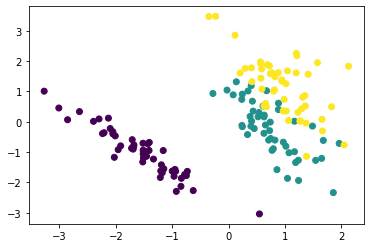
@fonnesbeck Should we temporarily change the example in the notebook to GP-LVM model?
Anyways, I have added the GP-LVM example in the notebook.
Thanks @AlexAndorra for the reviews. Have made the changes accordingly. Feel free to inform me if I missed something...
This all looks good to me, unless @bwengals has any concerns before we merge. I will test it on a couple simple models I am currently working with.
I don't understand the test failures. Is that a temporary glitch or something has changed?