

 objectionary
both `0.eq 0.0` and `0.0.eq 0` equal to `TRUE`
It happens because byte array of 0.0 and byte array of 0 have the same length equal to 8 (since all int objects cast to long in the core of eo) and these arrays are identical (they both consist of zeros).
I think it's a bug because, for example, both 10.eq 10.0 and 10.0.eq 10 are FALSE
UPD: this behavior below is also weird:
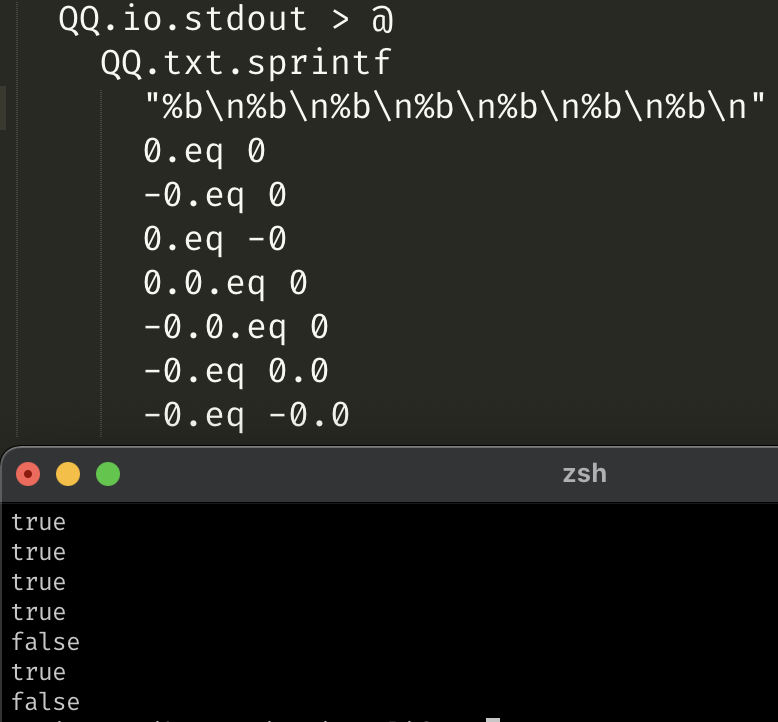

@maxonfjvipon I don't think this is a bug since int and float are 8 bytes. But it's still a good issue. We need to add some kind of type checking. Maybe you have a solution?

@Graur we can try to use sign bit for an indirect purpose. We can say that 0 is 0x00000000 and 0.0 is 0x80000000 (which is -0 in IEEE but we don't have -0 in EO). Then in java at place where we transform int or float to byte array we can add zero check.
I also thought about using 7 or 9 bytes array for 0, but it may break other code or cause integer overflow.
@maxonfjvipon I think I like the idea about -0.0 (with an extra bit set to one)

@yegor256 could you please tell me how I can run the test inside eo-runtime separately? I need to test and debug Param.asBytes() method
@maxonfjvipon make a ticket, complain about the absence of documentation in README.