objectionary
Check if object is NaN or is Infinity while converting to Phi object
In some cases we can get NaN or Infinities as a result of object dataization.
For example:
-
0.0.div 0.0=>nan, -
1.0.div 0.0=>positive-infinity, -
(number nan).ln=>nan(natural logarithm, in progress) - etc...
NaN are Ifinities are double, so I suggest to do something like this:
private static Phi toPhi(final Object obj) {
    ...
    } else if (obj instanceof Double) {
        if (((Double) obj).isNaN()) {
            phi = new EOnan(Phi.Φ);
        } else {
            phi = new EOfloat(Phi.Φ);
        }
    }
    ....
}
And also add checking infinities here.
In that case we won't get an error when we do for example 0.0.div 0.0, we'll get nan object and will be able to work with it


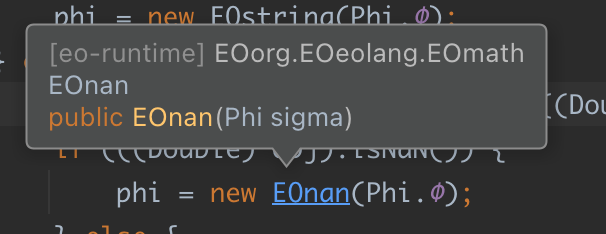
@maxonfjvipon it belongs to eo-math package. We can't use objects from this package inside eo-runtime. Well, technically we can, but this would be violation of "layered architecture" principle.
@maxonfjvipon @yegor256 I think we are already talk about it here: https://github.com/objectionary/eo/issues/774#issuecomment-1164312509

@yegor256 yeah, I remember, but it's more complicated)
Ok, I try to figure it out, but I think eventually it must be done somehow. 0.0.div 0.0 has not to throw an exception. It should return nan object.
@yegor256 I did a little research and here's what I think.
Anyway we should move nan and infinities to eo-runtime. I believe it's the place where they belong to. Even in Java NaN belong to Double class. In other cases we won't be able to solve this problem.
After we move them we can solve it in two ways.
- Easy. As I described above - add extra conditions to
toPhi. There'll be no cross layering anymore becausenan,infinitiesandfloatare in the same package. - Not easy and maybe not even worth to be discussed. As I suggested here: try to add some new EO syntax.
@maxonfjvipon I have another proposal. How about we make sure div doesn't throw an exception but returns float, which is nan (byte wise)?
@yegor256 so the result of 0.0.div 0.0 will be float object, but with bytes of nan.
0.0.div 0.0 > x # EOfloat
QQ.math.nan > n # EOnan
Here we should make sure that x and n have the same amount of inner objects with the same behavior
Won't it be some kind of crutch? Not really float and not really nan (from eo perspective)
@yegor256 It seems some objects like float.lt|lte|gte may not work correctly. Even float.eq
(0.0.div 0.0).eq nan # it'll be TRUE, but has to be FALSE
(0.0.div 0.0).eq nan # it'll be TRUE, but has to be FALSE
@maxonfjvipon As I remember, dividing by 0.0 leads to signed infinity
@yegor256 @Graur WDYT?
- move
nanto eo-runtime (or not) - make
0.0.div 0.0returnfloatbut withnanbytes (Double.NaN) - make
nandecorated0.0.div 0.0
[] > nan
  0.0.div 0.0 > @
- extend
float.eo: to every inner object that is implemented in EO add check if self as bytes equal tonan.as-bytes(ifnanwon't be moved - take this nan bytes somewhere else) (btwfloatobject useseo-collectionobjects, isn't it a cross-layer violation?) For example:
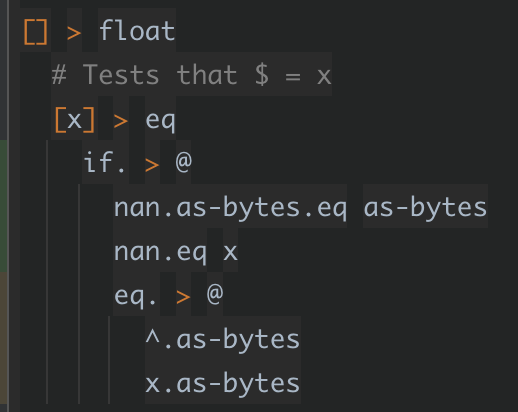
In that case we will get:
0.0.div 0.0 # float that behaves like nan
(0.0.div 0.0).div <any> # should be Double.NaN / <any> = Double.NaN => float that behaves like nan
nan.div <any> # nan - from nan object
4.2.div nan # nan decorates (0.0.div 0.0), so in java it'll be dataized to Double.NaN => 4.2 / Double.NaN = Double.NaN => float that behaves like nan
Resume:
- Move
nan,positive-infinityandnegative-infinitytoeo-runtimeand place them insidefloatobject - Add decoratees to these objects so they can be dataized to java primitives
- Allow division by float zero
- Add extra checks to
Data.ToPhi.toPhi(), for example:
if (((Double) obj).isNaN()) {
    phi = new EOfloat$EOnan(Phi.Φ);
}
I believe I didn't miss anything. @Graur please assign me. Can you set a 60 minutes budget?
@maxonfjvipon Sure, but it's always better to split this task to several puzzles by 30 min each. Please, use pdd for such cases. I suggest at least 4 pdd puzzles with 30 min budget each.