

 oantolin
Request/suggestion: support ^-prefix and $-suffix to STRICT leading and ending initialisms
First of all, thanks for your work. Your project(s) look very interesting.
I am an Ivy and Spacemacs user. In Spacemacs, Ivy opens with the ^ as initial-input by default. It means that we want to match from the beginning of some expression. If we don't want to match the beginning, we simply remove the ^ with backspace or, as a better alternative, just insert a SPC first. Also in Spacemacs M-x is mapped to SPC SPC so if we do not want to match from beginning we just type triple space.
Anyway, I would suggest that orderless offers the option to insert a ^ by default, and furthermore, the option to indicate when using initialisms, by pre-/suf-fixing the first and last characters that they should match the initials of the first and last words (if it should not match the first initial than we could insert a SPC first).
I hope my explanation is clear enough, and that you find it a useful suggestion (of course this is just taken from Ivy).

Here is a video
- I first type
SPCtwice - then I type
SPCthree times - subsequently I ad
pe - and finally I add the $ to tell 'pe' should match the final part (and after that I stop the
gif-screencast)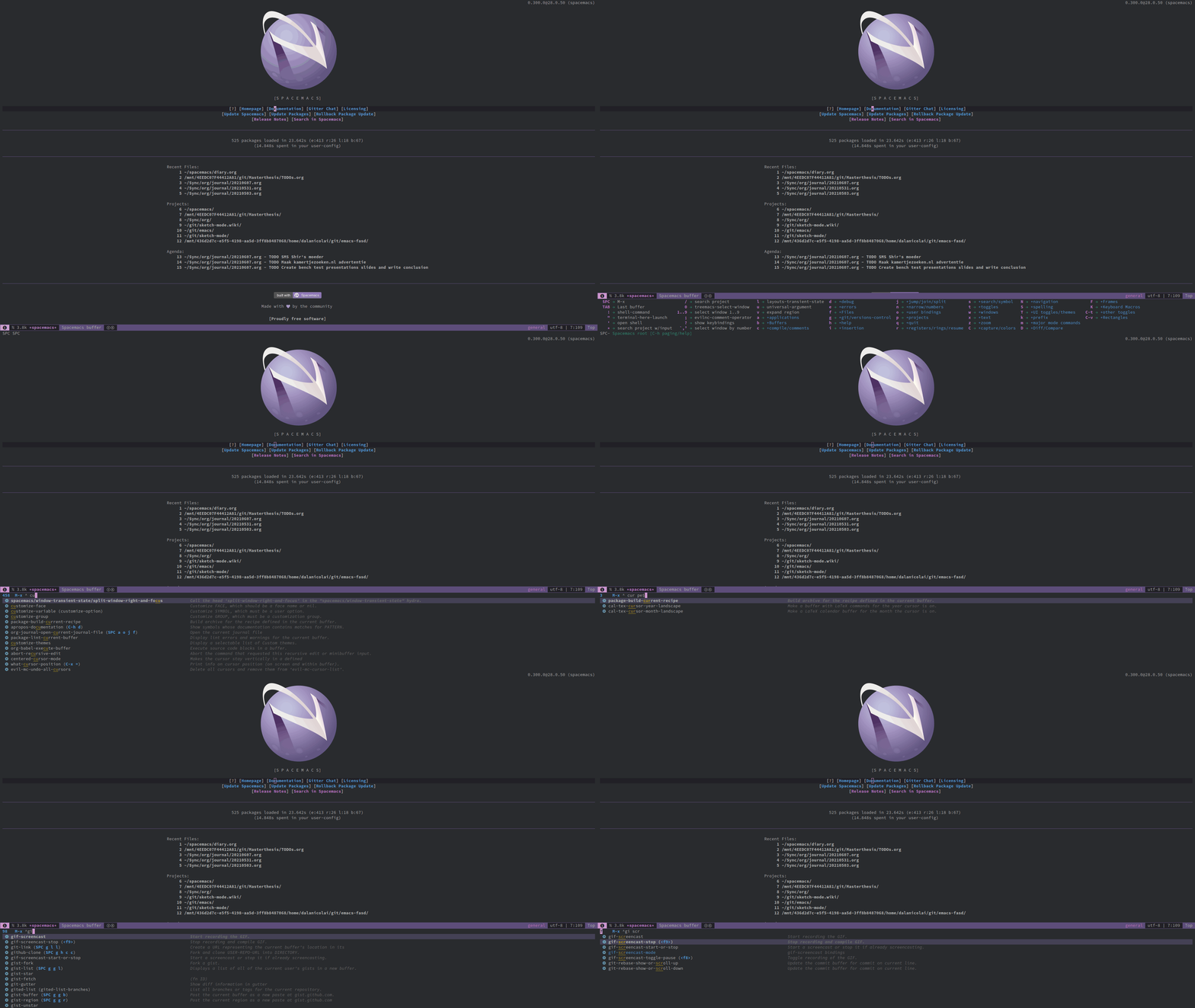
I am not sure I understand you fully here, but orderless style dispatchers allow at least to prefix the first component with "^". In Orderless almost nothing is hard coded, the user should write their own orderless style dispatchers and configure the desired orderless matching styles (initialism etc).

Maybe the style dispatchers I am using are helpful for your use case: https://github.com/minad/consult/wiki#orderless-style-dispatchers-ensure-that-the--regexp-works-with-consult-buffer. My configuration has a bit of special casing for Consult and Corfu completion-in-region and is a bit primitive. Omar has a more sophisticated configuration in his https://github.com/oantolin/emacs-config.
If you really want to insert initial input by default you can do this:
(advice-add #'vertico--setup :after #'insert-circumflex)
(defvar insert-circumflex-exclude nil
   "List of commands where circumflex should not be inserted.")
(defun insert-circumflex ()
  (unless (memq this-command insert-circumflex-exclude)
    (insert "^")))
But I am very hesitant to recommend something like this. It will break commands and it will break most completion styles, which don't understand regular expressions.
@minad Haha, I am also not sure if I understand you correctly, but what I mean is, I think, really quite straightforward.
It seems that initialism 'patterns' don't recognize ^ and $, but instead orderless offers different completion styles for it, namely orderless-initialism, orderless-strict-leading-initialism and orderless-strict-full-initialism.
So my request is for support of going from orderless-initialism to orderless-strict-leading-initialism by prepending the pattern with a ^, and going from strict-leading to strict-full by also appending a $. So that we do not need to configure the different completion styles. I hope this is more clearly explained now.
If there is support already for this, then my request is to document it more prominently.
So I am not sure if this is covered by your suggestions and advice, I only quickly skimmed them, but I could not immediately recognize the 'fix' for this request.
Anyway, still very useful info of course. I will take a closer look when I find some time again soon. Thanks again of course!
I'm a little confused with all this talk about initialisms. In your GIF you show ^cur matching cursor-sensor-mode. That is what orderless calls regexp matching (which it not only supports but is on by default), not initialism matching. Initialism matching means each letter is matched at a word boundary (more precisely at the start of a word), for example as an initialism cur would match comment-or-uncomment-region because the 1st, 3rd and 4th words start with c, u, r.
So maybe what you want is just regexp matching? Out of the box ^cur and the version with an extra space do match as in your GIF.

@oantolin I am specifically talking about initialisms (I explicitly explained how this syntax can 'replace' those three 'initialism completion styles' that I mentioned in my previous comment). I know the regexp matching already supports what I want, and for that I only requested to provide the option to insert the ^ by default, but it looks like @minad provided the solution for that already. So now it is only about 'extending' the syntax for initialisms. The screencast was just to show you/explain the behavior in Ivy which indeed only supports regexps (I think).
Oh, I see. Well ^ and $ can't really express whether an intialism matches strictly or not. "Strictly" means you are not allowed to skip any words. For example, I said cur matches comment-or-uncomment-region as an initialism but it does not match as a strict initialism because we skipped the word or. So you can't replace the strict styles by expanding orderless-initialism to allow anchors.
Of course, you may want the anchor extension anyway, even if it does not replace the strict initialism matching styles.
Okay, I misunderstood/not well considered the strict part, but it is more about the meaning of the 'leading' and `full' in those styles. I guess this should be perfectly possible with the proposed syntax...
As far as I did my experiments correctly, I found that it is not possible with current initialism syntax, to indicate that the first letter should only match with the beginning of the 'symbol` by prepending it with ^ (and similarly for $)
Yes, and it is fairly easy to do. A matching style is a function that takes a string and returns a regexp. Here you can leverage orderless-initialism for the middle part and just handle any initial ^ or final $:
(defun orderless-anchorable-initialism (pattern)
  (concat
   (if (string-prefix-p "^" pattern) "^" "")
   (orderless-initialism
    (string-remove-prefix "^" (string-remove-suffix "$" pattern)))
   (if (string-suffix-p "$" pattern) "[A-Za-z0-9]*$" "")))
Note that for $ I don't just tack on a $, because the last letter matches at the start of the last word, so instead we say "the rest of string is letters and numbers".
You may also want to similarly define an "anchorable prefixes" matching style.
Ah, I don't understand this immediately (as I do not fully understand dispatchers yet/did not use them yet), but I guess this must be a perfect solution to my request.
So, I would suggest adding this info to a more prominent place in the documentation (just suggestion of course).
So this sounds great! Many thanks for your advice and examples (also @minad)...
And your great work of course... the packages and their 'philosophy' look and sound really nice!