

 nvim-tree
Treat symbolic links as valid tree paths for root purposes
Is this a question? No.
Can this functionality be implemented utilizing API? Don't think so.
Is your feature request related to a problem? Please describe. I'm editing some project files that are symbolically linked in from somewhere else but his precludes nvim-tree showing a common root that isn't system root (/). For example:
the true path to these files is in /mnt/hgfs/vmshare/ . I am editing various files in /home/russianguyovic/project/ and have the files linked into /home/russianguyovic/project/headers/ (e.g. ln -s /mnt/hgfs/vmshare/ /home/russianguyovic/project/headers/). My tree root for all other files in the project is /home/russianguyovic/project/, however for the symbolically linked files that is not possible; the closest common root nvim-tree will acknowledge is the system root, / (root). If, while focused on some file /mnt/hgfs/vmshare/stuff.h one uses :cd /home/russianguyovic/project/, the tree very briefly blinks to the new root and then goes back to /mnt/hgfs/vmshare/. The solution would be for nvim-tree to look at link location rather than the target and treat that as the leaf from which to build a path back up towards system root.
Describe the solution you'd like nvim-tree should look at the link location, not the target, to determine where that leaf is relative to system root. (I feel like I'm doing a terrible job of explaining this. I would like the two groups of files mentioned above to both be able to use /home/russianguyovic/project/ as their nvim-tree root, to reference my hypothetical example.)
Describe alternatives you've considered The alternative is to just live with it.
Additional context
Imagine a directory structure like so with a linked-in folder, highlighted by a red box below:
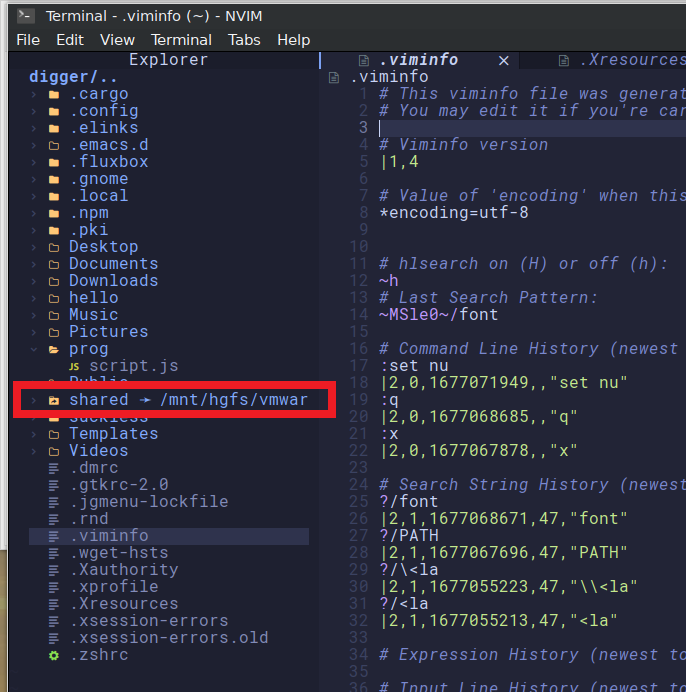 nvim-tree correctly shows the target of the symbolic link, which is cool, but it uses only the target for directory traversal pathing to determine possible roots:
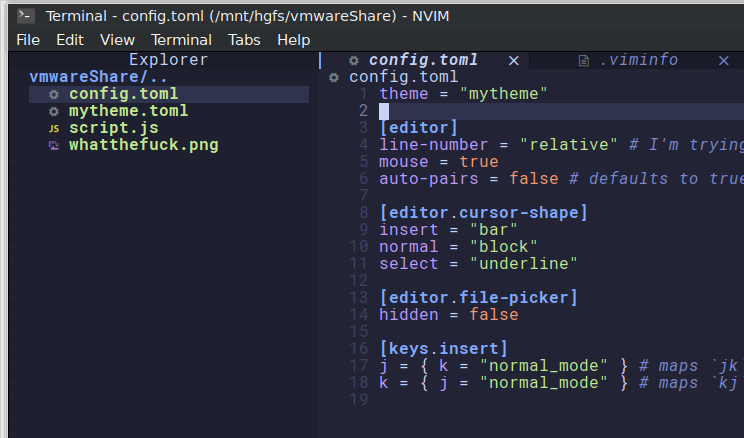 If I would like to see both .viminfo and config.toml in the tree at the same time, I can only do so by using system root as the root of the nvim-tree tree:
 This is less than ideal.

nvim-tree should look at the link location, not the target, to determine where that leaf is relative to system root.
That is reasonable. It appears that we are operating on the symlink's target rather than the symlink itself.
This fix/change could be considered non-breaking as the existing behaviour is not desirable.
