

 microsoft
[request] Simple (alternative) public api or static "make" function on objects
Hi,
I think it would be nice to have a simpler public API for scripting / hacking in the spirit of openscad, basically throwing all functions together in a single object, an example of what I mean would looks like this:
import { make } from 'makerjs'

const ball = make.ellipse(18, 18)
const hanger = make.move(make.ellipse(4, 4), [0, 18 + 2])
const ballInside = make.offset(ball, -2)
const hangerInside = make.offset(hanger, -2)
const ballAndHanger = make.union(ball, hanger)
const christmasBall = make.move({
    models: { ballAndHanger, ballInside, hangerInside }
}, [20, 20])
I have got the above somewhat working using my hack below:
interface Make {
    union: typeof maker.model.combineUnion,
    difference: typeof maker.model.combineSubtraction,
    intersection: typeof maker.model.combineIntersection,
}

const make: Make = {
    ...(Object.keys(maker.models).reduce((memo: any, modelName: string) => {
        const lcFirstModelName = modelName.charAt(0).toLowerCase() + modelName.slice(1);
        memo[lcFirstModelName] = (...args: any[]) => new maker.models[modelName](...args)
        return memo
    }, {})),
    ...(Object.keys(maker.model).reduce((memo: any, modelName: string) => {
        memo[modelName] = (...args: any[]) => new maker.model[modelName](...args)
        return memo
    }, {})),
    union: maker.model.combineUnion,
    difference: maker.model.combineSubtraction,
    intersection: maker.model.combineIntersection,
    offset: (modelToOutline: maker.IModel, offset: number, joints: number = 0) => {
        return maker.model.outline(modelToOutline, Math.abs(offset), joints, offset < 0)
    },
    // ... etc
However, the types of the model constructors are not working (as expected) so I would like to turn the above into something like:
const make = {
    belt: maker.models.Belt.make,
    bezierCurve: maker.models.BezierCurve.make,
    // ...etc
}
Most of the models constructors have overloads, which means I would have to re-implement them & keep them up to date (unless there is another way to do it that I am not aware of?) So I am wondering if it's possible to get this into the core (not necessarily the simple api, but at least the static "make" functions that construct a new instance of those model classes)
Hope this makes sense,
- Koen

Hi @vespakoen , are you using TypeScript? One thing you may want to look at, I am also doing some code generation. I save a copy of the AST here. This script looks at the AST and produces this file. At runtime, I use pretty much the same technique as you describe, here and here.

Hey dan, yes I am using TypeScript indeed, I am trying to shorten all the method calls from makerjs, but I want to keep the type information intact (for auto completion / documentation when scripting)
makerjs.$ seems to preserve it correctly indeed, just not sure if it will work with constructing models (which is the main thing I want to simplify).
eg something like:
make.ellipse(some, params)
// versus
new makerjs.models.Ellipse(some, params)
I can do something like:
export function belt(leftRadius: number, distance: number, rightRadius: number) {
  return new makerjs.models.Belt(leftRadius, distance, rightRadius)
}
however, it get's more tricky when there are overloads used in the constructor:
export function bezierCurve(points: IPoint[], accuracy?: number);
export function bezierCurve(seed: IPathBezierSeed, accuracy?: number);
export function bezierCurve(origin: IPoint, control: IPoint, end: IPoint, accuracy?: number);
export function bezierCurve(origin: IPoint, controls: IPoint[], end: IPoint, accuracy?: number);
export function bezierCurve(origin: IPoint, control1: IPoint, control2: IPoint, end: IPoint, accuracy?: number);
export function bezierCurve(...args: any[]) {
    var isArrayArg0 = Array.isArray(args[0]);
    switch (args.length) {
        case 2:
            if (isArrayArg0) {
                return new makerjs.model.BezierCurve(args[0] as IPoint[], args[1] as number);
            } else {
                return new makerjs.model.BezierCurve(args[0] as IPathBezierSeed, args[1] as number);
            }
        case 1:
            // etc
}
Which works fine but means I have to re-implement the constructor logic for all those types. My question is if we can put this kind of logic on the models themselves, for example
class BezierCurve implements IModel {
    // stuff

    static make(points: IPoint[], accuracy?: number);
    static make(seed: IPathBezierSeed, accuracy?: number);
    static make(origin: IPoint, control: IPoint, end: IPoint, accuracy?: number);
    static make(origin: IPoint, controls: IPoint[], end: IPoint, accuracy?: number);
    static make(origin: IPoint, control1: IPoint, control2: IPoint, end: IPoint, accuracy?: number);
    static make(...args: any[]) {
        var isArrayArg0 = Array.isArray(args[0]);
        switch (args.length) {
            case 2:
                if (isArrayArg0) {
                    return new BezierCurve(args[0] as IPoint[], args[1] as number);
                } else {
                    return new BezierCurve(args[0] as IPathBezierSeed, args[1] as number);
                }
            case 1:
                // etc
    }

    // other stuff
}
I am hoping that when it's a static method it's easier for me to remap it to something else, e.g.:
export function bezierCurve = makerjs.models.BezierCurve.make
Hope that clears things up
Hi @vespakoen , I see what you mean about the static methods for constructors. I have actually been wanting to do something like this, but for performance reasons. I want to avoid the switch statement that decides how to handle the construction. So, what I think I'd like is a different name for each static function, based of its parameters. Example:
class BezierCurve implements IModel {
    // stuff

    static bezierCurveFromPointArray(points: IPoint[], accuracy?: number);
    static bezierCurveFromSeed(seed: IPathBezierSeed, accuracy?: number);
    static bezierCurveQuadratic(origin: IPoint, control: IPoint, end: IPoint, accuracy?: number);
    static bezierCurveCubic(origin: IPoint, controls: IPoint[], end: IPoint, accuracy?: number);
    static bezierCurveCubicExplicit(origin: IPoint, control1: IPoint, control2: IPoint, end: IPoint, accuracy?: number);

    // other stuff
}
Do you think this idea is compatible with your make proposal?
Hi Dan,
That's great and would totally work for my purposes as well!
Perhaps use the make prefix?
class BezierCurve implements IModel {
    // stuff
    static makeFromPointArray(points: IPoint[], accuracy?: number);
    static makeFromSeed(seed: IPathBezierSeed, accuracy?: number);
    static makeQuadratic(origin: IPoint, control: IPoint, end: IPoint, accuracy?: number);
    static makeCubic(origin: IPoint, controls: IPoint[], end: IPoint, accuracy?: number);
    static makeCubicExplicit(origin: IPoint, control1: IPoint, control2: IPoint, end: IPoint, accuracy?: number);
    // other stuff
}
Perhaps you still want to have bezierCurve in the name, when you use it from the make namespace:
var b = make.bezierCurveQuadratic(...)
another thought, is you actually don't need to re-implement each overload. Just use the apply keyword. This is already provided with makerjs.kit:
var make = {
  bezierCurve: function (args) {
    return makerjs.kit.construct(makerjs.models.BezierCurve, args);
  },
 ...
}
Ah yeah that makes sense, then it would indeed be cool to have the "bezierCurve" prefix.
About the kit example, that wouldn't work as I want it to because the type information / documentation is lost.
So, to get the type information, you can write a script that looks at the signatures in the AST. Here are the signatures for BezierCurve for example. Then you can generate a TypeScript source file witha Node.js script.
That seems like a good solution, but if you are planning to add the static methods i'll wait for that or possibly make a PR for that someday =)
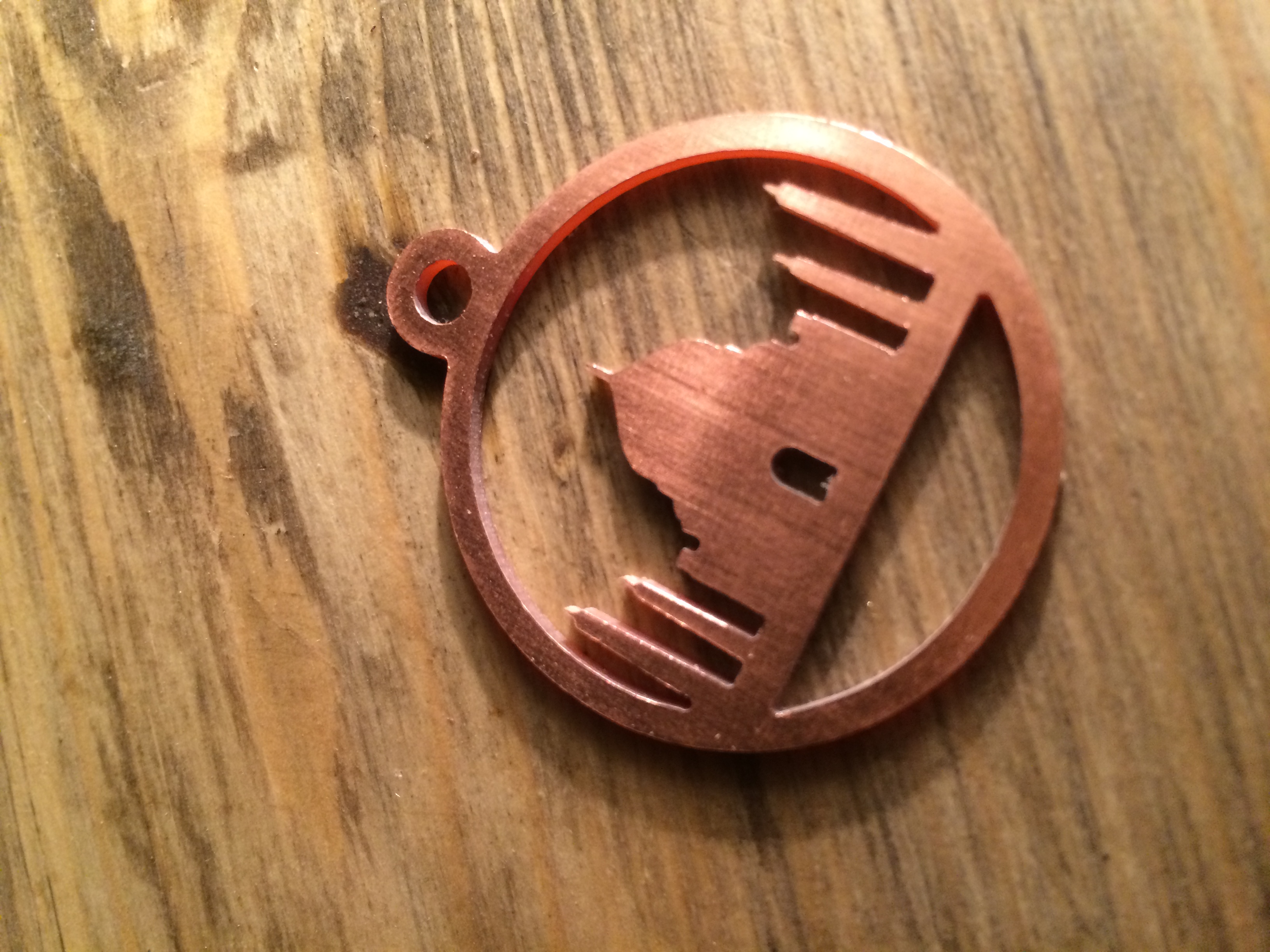
By the way, today I milled my first thing using my openjscam project together with makerjs, I also created another package (called makercam) that takes models from makerjs and turns them into CNC operations (right now I have contour, pocket and trace implemented) will push that stuff online soon and post a link.
Here is the result =)
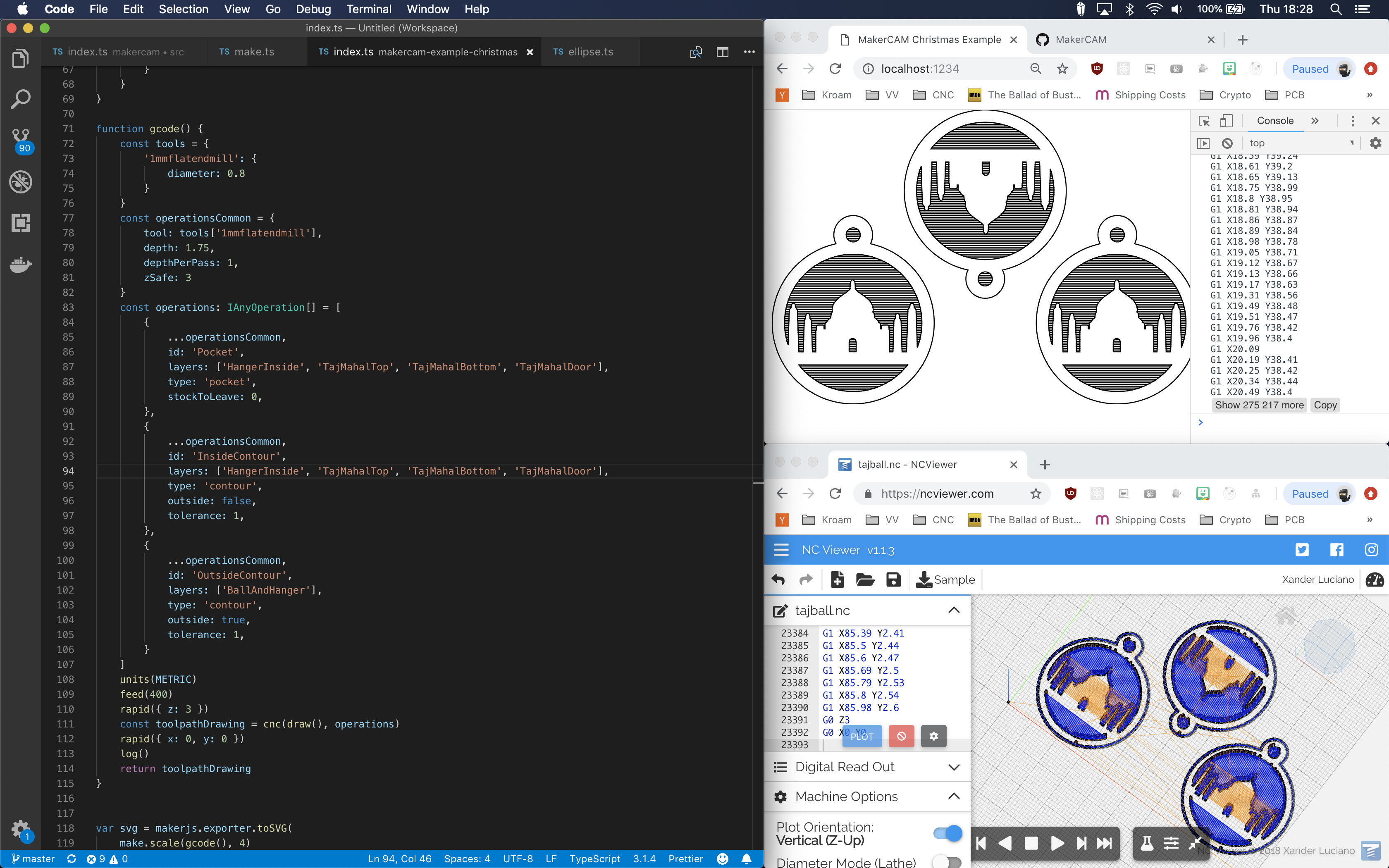
I used jsClipper for now to make the offsets, beware, messy code ahead:
const EndTypes = {
    etOpenSquare: 0,
    etOpenRound: 1,
    etOpenButt: 2,
    etClosedPolygon: 3,
    etClosedLine: 4
};

const JoinTypes = [
    ClipperLib.JoinType.jtSquare,
    ClipperLib.JoinType.jtRound,
    ClipperLib.JoinType.jtMiter
]

function clipperOffset(modelToOutline: maker.IModel, offset: number, joints: number = 0) {
    const scale = 100
    const chains = maker.model.findChains(modelToOutline) as maker.IChain[]
    const models = chains.reduce((memo, chain, i) => {
        const minimumSpacing = 0.1;
        const divisions = Math.floor(chain.pathLength / minimumSpacing);
        const spacing = chain.pathLength / divisions;
        const keyPoints = maker.chain.toPoints(chain, spacing);
        keyPoints.push(keyPoints[0])
        let paths = [
            keyPoints.map((point: any) =>
                ({
                    X: Math.round(point[0] * scale),
                    Y: Math.round(point[1] * scale)
                })
            )
        ]
        paths = ClipperLib.Clipper.SimplifyPolygons(paths, ClipperLib.PolyFillType.pftNonZero);
        // const cleanDelta = 0.001
        // paths = ClipperLib.JS.Clean(paths, cleanDelta * scale);
        // const endType = EndTypes.etClosedPolygon
        const co = new ClipperLib.ClipperOffset()
        const offsetted = new ClipperLib.Paths()
        co.Clear()
        co.AddPaths(paths, JoinTypes[joints], EndTypes.etClosedLine)
        co.MiterLimit = 0
        co.ArcTolerance = 0.25;
        co.Execute(offsetted, offset * scale);
        let result: maker.IPoint[] = []
        offsetted.forEach((points: any) => {
            points.forEach((point: any) => {
                result.push([point.X / scale, point.Y / scale])
            })
        })
        // @ts-ignore
        memo[i] = new maker.models.ConnectTheDots(true, result)
        return memo
    }, {})
    return {
        models
    }
}
And also found this module that is a WebAssembly version of ClipperLib: https://www.npmjs.com/package/js-angusj-clipper
It might be worth considering these for offsets / booleans etc?
I just uploaded the christmas ball script here:
https://github.com/makercam/makercam-example-christmas/blob/master/index.ts
And published all packages under the makercam namespace https://github.com/makercam
Note: it's a bit of a mess at the moment =)