

 dotnet
update middleware
EDIT by @Rick-Anderson : Update middleware doc
The documentation page Routing in ASP.NET Core § Routing basics has this to say:
Apps typically don't need to call
UseRoutingorUseEndpoints. WebApplicationBuilder configures a middleware pipeline that wraps middleware added inProgram.cswithUseRoutingandUseEndpoints. However, apps can change the order in whichUseRoutingandUseEndpointsrun by calling these methods explicitly.
So the conclusion is that it is fine to default to not calling UseRouting in Program.cs?
The documentation page ASP.NET Core Middleware § Middleware order seems to disagree:
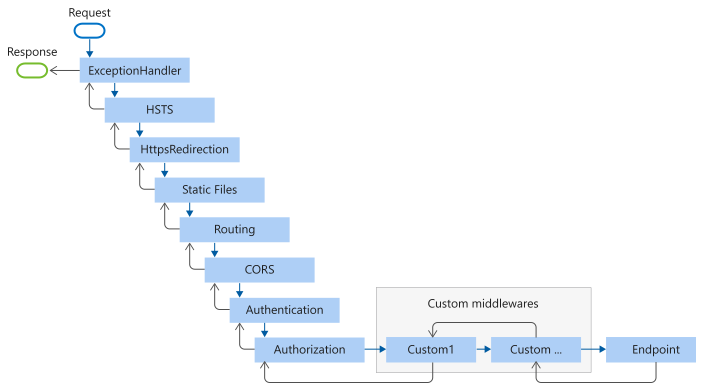
The following diagram shows the complete request processing pipeline for ASP.NET Core MVC and Razor Pages apps. You can see how, in a typical app, existing middlewares are ordered and where custom middlewares are added. You have full control over how to reorder existing middlewares or inject new custom middlewares as necessary for your scenarios.
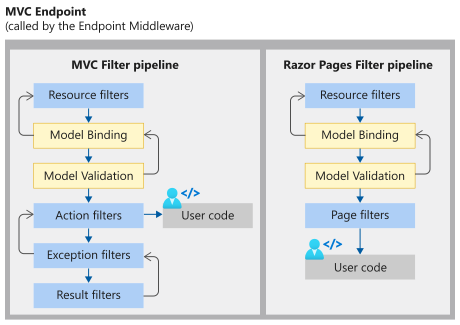
The Endpoint middleware in the preceding diagram executes the filter pipeline for the corresponding app type—MVC or Razor Pages.
The Routing middleware in the preceding diagram is shown following Static Files. This is the order that the project templates implement by explicitly calling app.UseRouting. If you don't call
app.UseRouting, the Routing middleware runs at the beginning of the pipeline by default. For more information, see Routing.
The order that middleware components are added in the
Program.csfile defines the order in which the middleware components are invoked on requests and the reverse order for the response. The order is critical for security, performance, and functionality.The following highlighted code in
Program.csadds security-related middleware components in the typical recommended order:using IndividualAccountsExample.Data; using Microsoft.AspNetCore.Identity; using Microsoft.EntityFrameworkCore; var builder = WebApplication.CreateBuilder(args); // Add services to the container. var connectionString = builder.Configuration.GetConnectionString("DefaultConnection"); builder.Services.AddDbContext<ApplicationDbContext>(options => options.UseSqlServer(connectionString)); builder.Services.AddDatabaseDeveloperPageExceptionFilter(); builder.Services.AddDefaultIdentity<IdentityUser>(options => options.SignIn.RequireConfirmedAccount = true) .AddEntityFrameworkStores<ApplicationDbContext>(); builder.Services.AddRazorPages(); var app = builder.Build(); // Configure the HTTP request pipeline. if (app.Environment.IsDevelopment()) { app.UseMigrationsEndPoint(); } else { app.UseExceptionHandler("/Error"); // The default HSTS value is 30 days. You may want to change this for production scenarios, see https://aka.ms/aspnetcore-hsts. app.UseHsts(); } app.UseHttpsRedirection(); app.UseStaticFiles(); // app.UseCookiePolicy(); app.UseRouting(); // app.UseRequestLocalization(); // app.UseCors(); app.UseAuthentication(); app.UseAuthorization(); // app.UseSession(); // app.UseResponseCompression(); // app.UseResponseCaching(); app.MapRazorPages(); app.MapControllerRoute( name: "default", pattern: "{controller=Home}/{action=Index}/{id?}"); app.Run();
(Highlighted are lines from // Configure the HTTP request pipeline. to // app.UseResponseCaching();, inclusively.)
So the bottom line of this docs page seems to be:
- In a typical recommended scenario
UseRoutingshould be called explicitly in this precise order, this is also whatdotnet newtemplates are doing - You may reorder middleware registrations or not call
UseRoutingexplicitly at all, in which case it will be implicitly called in the beginning of the pipeline, however - You need to know what you're doing, because you risk having security vulnerabilities, lagging performance and diminished functionality if you deviate from the templates.
This is quite different from the recommendation from the doc page about Routing, which says that "Apps typically don't need to call UseRouting".
I believe the docs pages should be reconciled. Either the Routing page or the Middleware page (or even both) should be edited depending on where the Routing middleware should be registered and if the order is critical for security, performance and functionality.
Document Details
⚠ Do not edit this section. It is required for docs.microsoft.com ➟ GitHub issue linking.
- ID: 9898482c-fa54-7ce2-1716-d14fbe03990d
- Version Independent ID: 3926c686-0ccc-f9fe-ca52-0134612a1623
- Content: ASP.NET Core Middleware
- Content Source: aspnetcore/fundamentals/middleware/index.md
- Product: aspnet-core
- Technology: aspnetcore-fundamentals
- GitHub Login: @Rick-Anderson
- Microsoft Alias: riande
Document Details
⚠ Do not edit this section. It is required for docs.microsoft.com ➟ GitHub issue linking.
- ID: 32374077-e02e-d6a6-1cea-05e58447b7cd
- Version Independent ID: 86aeab13-1c25-9fc1-4e56-0390cb40c242
- Content: Routing in ASP.NET Core
- Content Source: aspnetcore/fundamentals/routing.md
- Product: aspnet-core
- Technology: aspnetcore-fundamentals
- GitHub Login: @Rick-Anderson
- Microsoft Alias: riande
