
QATM
 QATM copied to clipboard
 cplusx
Code for Quality-Aware Template Matching for Deep Learning
QATM: Quality-Aware Template Matching for Deep Learning


This is the official repo for the QATM DNN layer (CVPR2019). For method details, please refer to
 @InProceedings{Cheng_2019_CVPR,
    author = {Cheng, Jiaxin and Wu, Yue and AbdAlmageed, Wael and Natarajan, Premkumar},
    title = {QATM: Quality-Aware Template Matching for Deep Learning},
    booktitle = {The IEEE Conference on Computer Vision and Pattern Recognition (CVPR)},
    month = {June},
    year = {2019}
    }
Overview
What is QATM?
QATM is an algorithmic DNN layer that implements template matching idea with learnable parameters.
How does QATM work?
QATM learns the similarity scores reflecting the (soft-)repeatness of a pattern. Emprically speaking, matching a background patch in QATM will produce a much lower score than matching a foreground patch.
Below is the table of ideal matching scores:
| Matching Cases | Likelihood(s|t) | Likelihood(t|s) | QATM Score(s,t) |
|---|---|---|---|
| 1-to-1 | 1 | 1 | 1 |
| 1-to-N | 1 | 1/N | 1/N |
| M-to-1 | 1/M | 1 | 1/M |
| M-to-N | 1/M | 1/N | 1/MN |
| Not Matching | 1/||S|| | 1/||T|| | ~0 |
where
- s and t are two patterns in source and template images, respectively.
- ||S|| and ||T|| are the cardinality of patterns in source and template set.
- see more details in paper.
QATM Applications
Classic Template Matching
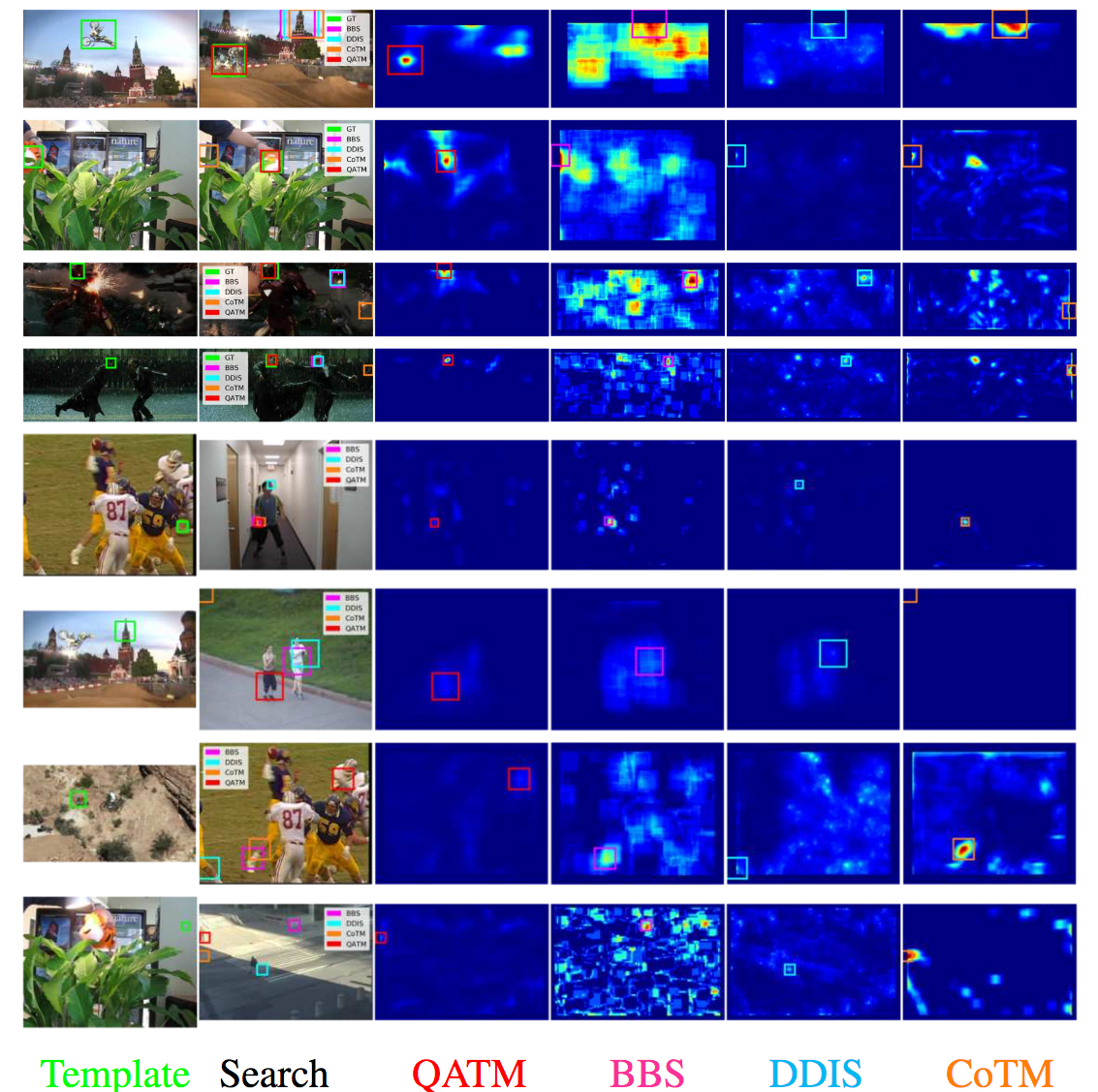 Figure 1: Qualitative template matching performance. Columns from left to right are: the
template frame, the target search frame with predicted bounding boxes overlaid (different colors indicate different method), and the response maps of QATM, BBS, DDIS, CoTM, respectively. Rows from top to bottom: the top four are positive samples
from OTB, while the bottom four are negative samples from MOTB. Best viewed in color and zoom-in mode. See detailed explanations in paper.
Figure 1: Qualitative template matching performance. Columns from left to right are: the
template frame, the target search frame with predicted bounding boxes overlaid (different colors indicate different method), and the response maps of QATM, BBS, DDIS, CoTM, respectively. Rows from top to bottom: the top four are positive samples
from OTB, while the bottom four are negative samples from MOTB. Best viewed in color and zoom-in mode. See detailed explanations in paper.
Deep Image-to-GPS Matching (Image-to-Panorama Matching)
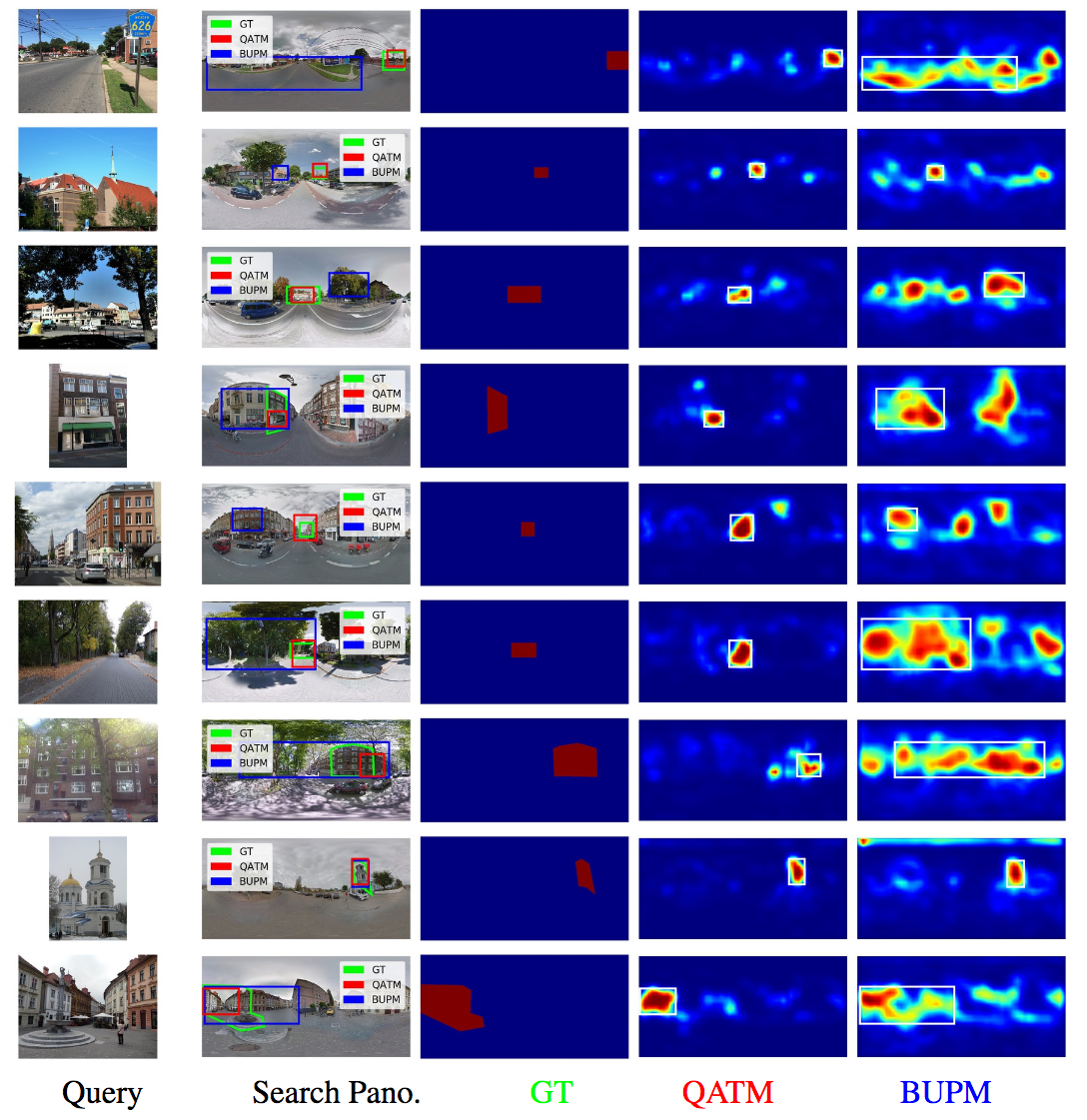 Figure 2: Qualitative image-to-GPS results. Columns from left to right are: the query image, the reference panorama
image with predicted bounding boxes overlaid (GT, the proposed QATM, and the baseline BUPM), and the response
maps of ground truth mask, QATM-improved, and baseline, respectively. Best viewed in color and zoom-in mode. See detailed explanations in paper.
Figure 2: Qualitative image-to-GPS results. Columns from left to right are: the query image, the reference panorama
image with predicted bounding boxes overlaid (GT, the proposed QATM, and the baseline BUPM), and the response
maps of ground truth mask, QATM-improved, and baseline, respectively. Best viewed in color and zoom-in mode. See detailed explanations in paper.
Deep Semantic Image Alignment
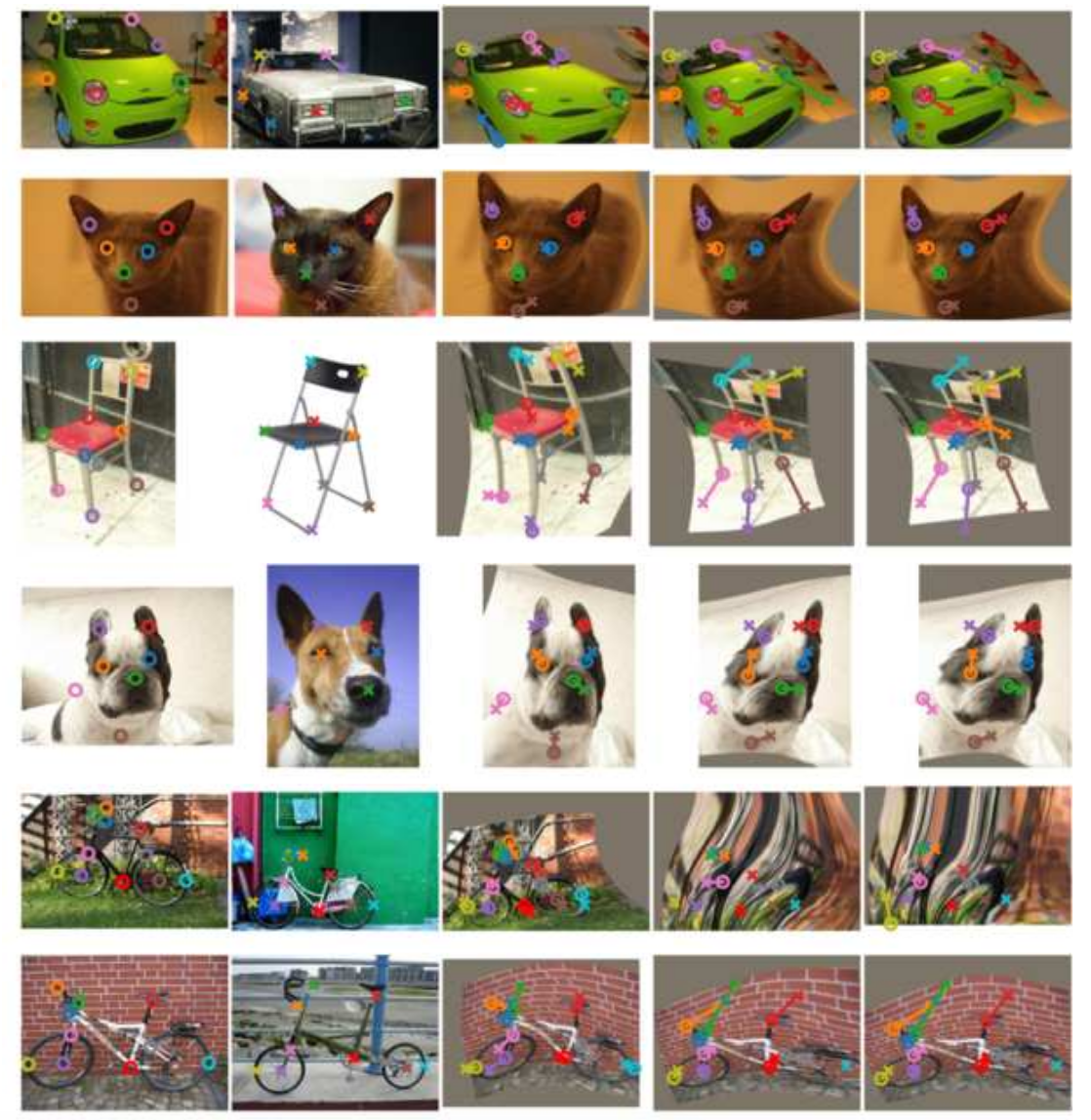 Figure 3: Qualitative results on PF-PASCAL dataset. Columns from left to right represent source image, target
image, transform results of QATM, GoeCNN and Weakly-supervisedSA. Circles and crosses indicate key points on source images
and target images. Best viewed in color and zoom-in mode. See detailed explanations in paper.
Figure 3: Qualitative results on PF-PASCAL dataset. Columns from left to right represent source image, target
image, transform results of QATM, GoeCNN and Weakly-supervisedSA. Circles and crosses indicate key points on source images
and target images. Best viewed in color and zoom-in mode. See detailed explanations in paper.
Others
See git repository https://github.com/kamata1729/QATM_pytorch.git
Dependencies
- Dependencies in our experiment, not necessary to be exactly same version but later version is preferred
- keras=2.2.4
- tensorflow=1.9.0
- opencv=4.0.0 (opencv>=3.1.0 should also works)
Demo Code
Run one sample
See run_single_sample.ipynb
Run OTB dataset in paper
See run_all_OTB.ipynb
 cplusx