

 cobbr
cobbr
[Issue] Domain Fronting - Grunt SNI points to Host header instead of ConnectAddress
I'm looking to set up an HTTPS listener with a TLS certificate , but the SSLCertificate doesn't seem to be handled properly. I see in docs it expects a pfx file, but it doesn't actually upload when the POST is sent to create the listener (just the filename). When the form returns with the SSLCertificate error, and I resubmit the form, a key constraint error is thrown resulting in a 500 error.
Screenshots and details below.


fail: Microsoft.EntityFrameworkCore.Database.Command[20102]
      Failed executing DbCommand (1ms) [Parameters=[@p0='?', @p1='?' (Size = 7), @p2='?', @p3='?' (Size = 10), @p4='?', @p5='?' (Size = 516), @p6='?' (Size = 25), @p7='?' (Size = 12), @p8='?' (Size = 10), @p9='?', @p10='?' (Size = 10), @p11='?', @p12='?', @p13='?', @p14='?', @p15='?' (Size = 8), @p16='?' (Size = 22), @p17='?'], CommandType='Text', CommandTimeout='30']
      INSERT INTO "Listeners" ("Id", "BindAddress", "BindPort", "ConnectAddress", "ConnectPort", "CovenantToken", "Description", "Discriminator", "GUID", "ListenerTypeId", "Name", "ProfileId", "StartTime", "Status", "SSLCertificate", "SSLCertificatePassword", "Url", "UseSSL")
      VALUES (@p0, @p1, @p2, @p3, @p4, @p5, @p6, @p7, @p8, @p9, @p10, @p11, @p12, @p13, @p14, @p15, @p16, @p17);
Microsoft.Data.Sqlite.SqliteException (0x80004005): SQLite Error 19: 'UNIQUE constraint failed: Listeners.Id'.
   at Microsoft.Data.Sqlite.SqliteException.ThrowExceptionForRC(Int32 rc, sqlite3 db)
   at Microsoft.Data.Sqlite.SqliteCommand.ExecuteReader(CommandBehavior behavior)
   at Microsoft.Data.Sqlite.SqliteCommand.ExecuteReaderAsync(CommandBehavior behavior, CancellationToken cancellationToken)
   at Microsoft.Data.Sqlite.SqliteCommand.ExecuteDbDataReaderAsync(CommandBehavior behavior, CancellationToken cancellationToken)
   at Microsoft.EntityFrameworkCore.Storage.Internal.RelationalCommand.ExecuteAsync(IRelationalConnection connection, DbCommandMethod executeMethod, IReadOnlyDictionary`2 parameterValues, CancellationToken cancellationToken)
fail: Microsoft.EntityFrameworkCore.Update[10000]
      An exception occurred in the database while saving changes for context type 'Covenant.Models.CovenantContext'.
      Microsoft.EntityFrameworkCore.DbUpdateException: An error occurred while updating the entries. See the inner exception for details. ---> Microsoft.Data.Sqlite.SqliteException: SQLite Error 19: 'UNIQUE constraint failed: Listeners.Id'.
         at Microsoft.Data.Sqlite.SqliteException.ThrowExceptionForRC(Int32 rc, sqlite3 db)
         at Microsoft.Data.Sqlite.SqliteCommand.ExecuteReader(CommandBehavior behavior)
         at Microsoft.Data.Sqlite.SqliteCommand.ExecuteReaderAsync(CommandBehavior behavior, CancellationToken cancellationToken)
         at Microsoft.Data.Sqlite.SqliteCommand.ExecuteDbDataReaderAsync(CommandBehavior behavior, CancellationToken cancellationToken)
         at Microsoft.EntityFrameworkCore.Storage.Internal.RelationalCommand.ExecuteAsync(IRelationalConnection connection, DbCommandMethod executeMethod, IReadOnlyDictionary`2 parameterValues, CancellationToken cancellationToken)
         at Microsoft.EntityFrameworkCore.Update.ReaderModificationCommandBatch.ExecuteAsync(IRelationalConnection connection, CancellationToken cancellationToken)
         --- End of inner exception stack trace ---
         at Microsoft.EntityFrameworkCore.Update.ReaderModificationCommandBatch.ExecuteAsync(IRelationalConnection connection, CancellationToken cancellationToken)
         at Microsoft.EntityFrameworkCore.Update.Internal.BatchExecutor.ExecuteAsync(DbContext _, ValueTuple`2 parameters, CancellationToken cancellationToken)
         at Microsoft.EntityFrameworkCore.ChangeTracking.Internal.StateManager.SaveChangesAsync(IReadOnlyList`1 entriesToSave, CancellationToken cancellationToken)
         at Microsoft.EntityFrameworkCore.ChangeTracking.Internal.StateManager.SaveChangesAsync(Boolean acceptAllChangesOnSuccess, CancellationToken cancellationToken)
         at Microsoft.EntityFrameworkCore.DbContext.SaveChangesAsync(Boolean acceptAllChangesOnSuccess, CancellationToken cancellationToken)
Microsoft.EntityFrameworkCore.DbUpdateException: An error occurred while updating the entries. See the inner exception for details. ---> Microsoft.Data.Sqlite.SqliteException: SQLite Error 19: 'UNIQUE constraint failed: Listeners.Id'.
   at Microsoft.Data.Sqlite.SqliteException.ThrowExceptionForRC(Int32 rc, sqlite3 db)
   at Microsoft.Data.Sqlite.SqliteCommand.ExecuteReader(CommandBehavior behavior)
   at Microsoft.Data.Sqlite.SqliteCommand.ExecuteReaderAsync(CommandBehavior behavior, CancellationToken cancellationToken)
   at Microsoft.Data.Sqlite.SqliteCommand.ExecuteDbDataReaderAsync(CommandBehavior behavior, CancellationToken cancellationToken)
   at Microsoft.EntityFrameworkCore.Storage.Internal.RelationalCommand.ExecuteAsync(IRelationalConnection connection, DbCommandMethod executeMethod, IReadOnlyDictionary`2 parameterValues, CancellationToken cancellationToken)
   at Microsoft.EntityFrameworkCore.Update.ReaderModificationCommandBatch.ExecuteAsync(IRelationalConnection connection, CancellationToken cancellationToken)
   --- End of inner exception stack trace ---
   at Microsoft.EntityFrameworkCore.Update.ReaderModificationCommandBatch.ExecuteAsync(IRelationalConnection connection, CancellationToken cancellationToken)
   at Microsoft.EntityFrameworkCore.Update.Internal.BatchExecutor.ExecuteAsync(DbContext _, ValueTuple`2 parameters, CancellationToken cancellationToken)
   at Microsoft.EntityFrameworkCore.ChangeTracking.Internal.StateManager.SaveChangesAsync(IReadOnlyList`1 entriesToSave, CancellationToken cancellationToken)
   at Microsoft.EntityFrameworkCore.ChangeTracking.Internal.StateManager.SaveChangesAsync(Boolean acceptAllChangesOnSuccess, CancellationToken cancellationToken)
   at Microsoft.EntityFrameworkCore.DbContext.SaveChangesAsync(Boolean acceptAllChangesOnSuccess, CancellationToken cancellationToken)
fail: Microsoft.AspNetCore.Server.Kestrel[13]
      Connection id "0HLP3C6FNE726", Request id "0HLP3C6FNE726:0000000F": An unhandled exception was thrown by the application.
Microsoft.EntityFrameworkCore.DbUpdateException: An error occurred while updating the entries. See the inner exception for details. ---> Microsoft.Data.Sqlite.SqliteException: SQLite Error 19: 'UNIQUE constraint failed: Listeners.Id'.
   at Microsoft.Data.Sqlite.SqliteException.ThrowExceptionForRC(Int32 rc, sqlite3 db)
   at Microsoft.Data.Sqlite.SqliteCommand.ExecuteReader(CommandBehavior behavior)
   at Microsoft.Data.Sqlite.SqliteCommand.ExecuteReaderAsync(CommandBehavior behavior, CancellationToken cancellationToken)
   at Microsoft.Data.Sqlite.SqliteCommand.ExecuteDbDataReaderAsync(CommandBehavior behavior, CancellationToken cancellationToken)
   at Microsoft.EntityFrameworkCore.Storage.Internal.RelationalCommand.ExecuteAsync(IRelationalConnection connection, DbCommandMethod executeMethod, IReadOnlyDictionary`2 parameterValues, CancellationToken cancellationToken)
   at Microsoft.EntityFrameworkCore.Update.ReaderModificationCommandBatch.ExecuteAsync(IRelationalConnection connection, CancellationToken cancellationToken)
   --- End of inner exception stack trace ---
   at Microsoft.EntityFrameworkCore.Update.ReaderModificationCommandBatch.ExecuteAsync(IRelationalConnection connection, CancellationToken cancellationToken)
   at Microsoft.EntityFrameworkCore.Update.Internal.BatchExecutor.ExecuteAsync(DbContext _, ValueTuple`2 parameters, CancellationToken cancellationToken)
   at Microsoft.EntityFrameworkCore.ChangeTracking.Internal.StateManager.SaveChangesAsync(IReadOnlyList`1 entriesToSave, CancellationToken cancellationToken)
   at Microsoft.EntityFrameworkCore.ChangeTracking.Internal.StateManager.SaveChangesAsync(Boolean acceptAllChangesOnSuccess, CancellationToken cancellationToken)
   at Microsoft.EntityFrameworkCore.DbContext.SaveChangesAsync(Boolean acceptAllChangesOnSuccess, CancellationToken cancellationToken)
   at Covenant.Models.CovenantContext.CreateHttpListener(UserManager`1 userManager, IConfiguration configuration, HttpListener listener, ConcurrentDictionary`2 _ListenerCancellationTokens, IHubContext`1 _eventhub) in /app/Models/CovenantContext.cs:line 2527
   at Covenant.Controllers.ListenerController.Create(HttpListener listener) in /app/Controllers/ViewControllers/ListenerController.cs:line 78
   at Microsoft.AspNetCore.Mvc.Internal.ActionMethodExecutor.TaskOfIActionResultExecutor.Execute(IActionResultTypeMapper mapper, ObjectMethodExecutor executor, Object controller, Object[] arguments)
   at System.Threading.Tasks.ValueTask`1.get_Result()
   at Microsoft.AspNetCore.Mvc.Internal.ControllerActionInvoker.InvokeActionMethodAsync()
   at Microsoft.AspNetCore.Mvc.Internal.ControllerActionInvoker.InvokeNextActionFilterAsync()
   at Microsoft.AspNetCore.Mvc.Internal.ControllerActionInvoker.Rethrow(ActionExecutedContext context)
   at Microsoft.AspNetCore.Mvc.Internal.ControllerActionInvoker.Next(State& next, Scope& scope, Object& state, Boolean& isCompleted)
   at Microsoft.AspNetCore.Mvc.Internal.ControllerActionInvoker.InvokeInnerFilterAsync()
   at Microsoft.AspNetCore.Mvc.Internal.ResourceInvoker.InvokeNextResourceFilter()
   at Microsoft.AspNetCore.Mvc.Internal.ResourceInvoker.Rethrow(ResourceExecutedContext context)
   at Microsoft.AspNetCore.Mvc.Internal.ResourceInvoker.Next(State& next, Scope& scope, Object& state, Boolean& isCompleted)
   at Microsoft.AspNetCore.Mvc.Internal.ResourceInvoker.InvokeFilterPipelineAsync()
   at Microsoft.AspNetCore.Mvc.Internal.ResourceInvoker.InvokeAsync()
   at Microsoft.AspNetCore.Routing.EndpointMiddleware.Invoke(HttpContext httpContext)
   at Microsoft.AspNetCore.Routing.EndpointRoutingMiddleware.Invoke(HttpContext httpContext)
   at Microsoft.AspNetCore.StaticFiles.StaticFileMiddleware.Invoke(HttpContext context)
   at Microsoft.AspNetCore.Authentication.AuthenticationMiddleware.Invoke(HttpContext context)
   at Microsoft.AspNetCore.Server.Kestrel.Core.Internal.Http.HttpProtocol.ProcessRequests[TContext](IHttpApplication`1 application)
fail: Microsoft.EntityFrameworkCore.Database.Command[20102]
      Failed executing DbCommand (1ms) [Parameters=[@p0='?', @p1='?' (Size = 7), @p2='?', @p3='?' (Size = 12), @p4='?', @p5='?' (Size = 516), @p6='?' (Size = 25), @p7='?' (Size = 12), @p8='?' (Size = 10), @p9='?', @p10='?' (Size = 18), @p11='?', @p12='?', @p13='?', @p14='?', @p15='?' (Size = 8), @p16='?' (Size = 24), @p17='?'], CommandType='Text', CommandTimeout='30']
      INSERT INTO "Listeners" ("Id", "BindAddress", "BindPort", "ConnectAddress", "ConnectPort", "CovenantToken", "Description", "Discriminator", "GUID", "ListenerTypeId", "Name", "ProfileId", "StartTime", "Status", "SSLCertificate", "SSLCertificatePassword", "Url", "UseSSL")
      VALUES (@p0, @p1, @p2, @p3, @p4, @p5, @p6, @p7, @p8, @p9, @p10, @p11, @p12, @p13, @p14, @p15, @p16, @p17);
Microsoft.Data.Sqlite.SqliteException (0x80004005): SQLite Error 19: 'UNIQUE constraint failed: Listeners.Id'.
   at Microsoft.Data.Sqlite.SqliteException.ThrowExceptionForRC(Int32 rc, sqlite3 db)
   at Microsoft.Data.Sqlite.SqliteCommand.ExecuteReader(CommandBehavior behavior)
   at Microsoft.Data.Sqlite.SqliteCommand.ExecuteReaderAsync(CommandBehavior behavior, CancellationToken cancellationToken)
   at Microsoft.Data.Sqlite.SqliteCommand.ExecuteDbDataReaderAsync(CommandBehavior behavior, CancellationToken cancellationToken)
   at Microsoft.EntityFrameworkCore.Storage.Internal.RelationalCommand.ExecuteAsync(IRelationalConnection connection, DbCommandMethod executeMethod, IReadOnlyDictionary`2 parameterValues, CancellationToken cancellationToken)
fail: Microsoft.EntityFrameworkCore.Update[10000]
      An exception occurred in the database while saving changes for context type 'Covenant.Models.CovenantContext'.
      Microsoft.EntityFrameworkCore.DbUpdateException: An error occurred while updating the entries. See the inner exception for details. ---> Microsoft.Data.Sqlite.SqliteException: SQLite Error 19: 'UNIQUE constraint failed: Listeners.Id'.
         at Microsoft.Data.Sqlite.SqliteException.ThrowExceptionForRC(Int32 rc, sqlite3 db)
         at Microsoft.Data.Sqlite.SqliteCommand.ExecuteReader(CommandBehavior behavior)
         at Microsoft.Data.Sqlite.SqliteCommand.ExecuteReaderAsync(CommandBehavior behavior, CancellationToken cancellationToken)
         at Microsoft.Data.Sqlite.SqliteCommand.ExecuteDbDataReaderAsync(CommandBehavior behavior, CancellationToken cancellationToken)
         at Microsoft.EntityFrameworkCore.Storage.Internal.RelationalCommand.ExecuteAsync(IRelationalConnection connection, DbCommandMethod executeMethod, IReadOnlyDictionary`2 parameterValues, CancellationToken cancellationToken)
         at Microsoft.EntityFrameworkCore.Update.ReaderModificationCommandBatch.ExecuteAsync(IRelationalConnection connection, CancellationToken cancellationToken)
         --- End of inner exception stack trace ---
         at Microsoft.EntityFrameworkCore.Update.ReaderModificationCommandBatch.ExecuteAsync(IRelationalConnection connection, CancellationToken cancellationToken)
         at Microsoft.EntityFrameworkCore.Update.Internal.BatchExecutor.ExecuteAsync(DbContext _, ValueTuple`2 parameters, CancellationToken cancellationToken)
         at Microsoft.EntityFrameworkCore.ChangeTracking.Internal.StateManager.SaveChangesAsync(IReadOnlyList`1 entriesToSave, CancellationToken cancellationToken)
         at Microsoft.EntityFrameworkCore.ChangeTracking.Internal.StateManager.SaveChangesAsync(Boolean acceptAllChangesOnSuccess, CancellationToken cancellationToken)
         at Microsoft.EntityFrameworkCore.DbContext.SaveChangesAsync(Boolean acceptAllChangesOnSuccess, CancellationToken cancellationToken)
Microsoft.EntityFrameworkCore.DbUpdateException: An error occurred while updating the entries. See the inner exception for details. ---> Microsoft.Data.Sqlite.SqliteException: SQLite Error 19: 'UNIQUE constraint failed: Listeners.Id'.
   at Microsoft.Data.Sqlite.SqliteException.ThrowExceptionForRC(Int32 rc, sqlite3 db)
   at Microsoft.Data.Sqlite.SqliteCommand.ExecuteReader(CommandBehavior behavior)
   at Microsoft.Data.Sqlite.SqliteCommand.ExecuteReaderAsync(CommandBehavior behavior, CancellationToken cancellationToken)
   at Microsoft.Data.Sqlite.SqliteCommand.ExecuteDbDataReaderAsync(CommandBehavior behavior, CancellationToken cancellationToken)
   at Microsoft.EntityFrameworkCore.Storage.Internal.RelationalCommand.ExecuteAsync(IRelationalConnection connection, DbCommandMethod executeMethod, IReadOnlyDictionary`2 parameterValues, CancellationToken cancellationToken)
   at Microsoft.EntityFrameworkCore.Update.ReaderModificationCommandBatch.ExecuteAsync(IRelationalConnection connection, CancellationToken cancellationToken)
   --- End of inner exception stack trace ---
   at Microsoft.EntityFrameworkCore.Update.ReaderModificationCommandBatch.ExecuteAsync(IRelationalConnection connection, CancellationToken cancellationToken)
   at Microsoft.EntityFrameworkCore.Update.Internal.BatchExecutor.ExecuteAsync(DbContext _, ValueTuple`2 parameters, CancellationToken cancellationToken)
   at Microsoft.EntityFrameworkCore.ChangeTracking.Internal.StateManager.SaveChangesAsync(IReadOnlyList`1 entriesToSave, CancellationToken cancellationToken)
   at Microsoft.EntityFrameworkCore.ChangeTracking.Internal.StateManager.SaveChangesAsync(Boolean acceptAllChangesOnSuccess, CancellationToken cancellationToken)
   at Microsoft.EntityFrameworkCore.DbContext.SaveChangesAsync(Boolean acceptAllChangesOnSuccess, CancellationToken cancellationToken)
fail: Microsoft.AspNetCore.Server.Kestrel[13]
      Connection id "0HLP3C6FNE72F", Request id "0HLP3C6FNE72F:00000003": An unhandled exception was thrown by the application.
Microsoft.EntityFrameworkCore.DbUpdateException: An error occurred while updating the entries. See the inner exception for details. ---> Microsoft.Data.Sqlite.SqliteException: SQLite Error 19: 'UNIQUE constraint failed: Listeners.Id'.
   at Microsoft.Data.Sqlite.SqliteException.ThrowExceptionForRC(Int32 rc, sqlite3 db)
   at Microsoft.Data.Sqlite.SqliteCommand.ExecuteReader(CommandBehavior behavior)
   at Microsoft.Data.Sqlite.SqliteCommand.ExecuteReaderAsync(CommandBehavior behavior, CancellationToken cancellationToken)
   at Microsoft.Data.Sqlite.SqliteCommand.ExecuteDbDataReaderAsync(CommandBehavior behavior, CancellationToken cancellationToken)
   at Microsoft.EntityFrameworkCore.Storage.Internal.RelationalCommand.ExecuteAsync(IRelationalConnection connection, DbCommandMethod executeMethod, IReadOnlyDictionary`2 parameterValues, CancellationToken cancellationToken)
   at Microsoft.EntityFrameworkCore.Update.ReaderModificationCommandBatch.ExecuteAsync(IRelationalConnection connection, CancellationToken cancellationToken)
   --- End of inner exception stack trace ---
   at Microsoft.EntityFrameworkCore.Update.ReaderModificationCommandBatch.ExecuteAsync(IRelationalConnection connection, CancellationToken cancellationToken)
   at Microsoft.EntityFrameworkCore.Update.Internal.BatchExecutor.ExecuteAsync(DbContext _, ValueTuple`2 parameters, CancellationToken cancellationToken)
   at Microsoft.EntityFrameworkCore.ChangeTracking.Internal.StateManager.SaveChangesAsync(IReadOnlyList`1 entriesToSave, CancellationToken cancellationToken)
   at Microsoft.EntityFrameworkCore.ChangeTracking.Internal.StateManager.SaveChangesAsync(Boolean acceptAllChangesOnSuccess, CancellationToken cancellationToken)
   at Microsoft.EntityFrameworkCore.DbContext.SaveChangesAsync(Boolean acceptAllChangesOnSuccess, CancellationToken cancellationToken)
   at Covenant.Models.CovenantContext.CreateHttpListener(UserManager`1 userManager, IConfiguration configuration, HttpListener listener, ConcurrentDictionary`2 _ListenerCancellationTokens, IHubContext`1 _eventhub) in /app/Models/CovenantContext.cs:line 2527
   at Covenant.Controllers.ListenerController.Create(HttpListener listener) in /app/Controllers/ViewControllers/ListenerController.cs:line 78
   at Microsoft.AspNetCore.Mvc.Internal.ActionMethodExecutor.TaskOfIActionResultExecutor.Execute(IActionResultTypeMapper mapper, ObjectMethodExecutor executor, Object controller, Object[] arguments)
   at System.Threading.Tasks.ValueTask`1.get_Result()
   at Microsoft.AspNetCore.Mvc.Internal.ControllerActionInvoker.InvokeActionMethodAsync()
   at Microsoft.AspNetCore.Mvc.Internal.ControllerActionInvoker.InvokeNextActionFilterAsync()
   at Microsoft.AspNetCore.Mvc.Internal.ControllerActionInvoker.Rethrow(ActionExecutedContext context)
   at Microsoft.AspNetCore.Mvc.Internal.ControllerActionInvoker.Next(State& next, Scope& scope, Object& state, Boolean& isCompleted)
   at Microsoft.AspNetCore.Mvc.Internal.ControllerActionInvoker.InvokeInnerFilterAsync()
   at Microsoft.AspNetCore.Mvc.Internal.ResourceInvoker.InvokeNextResourceFilter()
   at Microsoft.AspNetCore.Mvc.Internal.ResourceInvoker.Rethrow(ResourceExecutedContext context)
   at Microsoft.AspNetCore.Mvc.Internal.ResourceInvoker.Next(State& next, Scope& scope, Object& state, Boolean& isCompleted)
   at Microsoft.AspNetCore.Mvc.Internal.ResourceInvoker.InvokeFilterPipelineAsync()
   at Microsoft.AspNetCore.Mvc.Internal.ResourceInvoker.InvokeAsync()
   at Microsoft.AspNetCore.Routing.EndpointMiddleware.Invoke(HttpContext httpContext)
   at Microsoft.AspNetCore.Routing.EndpointRoutingMiddleware.Invoke(HttpContext httpContext)
   at Microsoft.AspNetCore.StaticFiles.StaticFileMiddleware.Invoke(HttpContext context)
   at Microsoft.AspNetCore.Authentication.AuthenticationMiddleware.Invoke(HttpContext context)
   at Microsoft.AspNetCore.Server.Kestrel.Core.Internal.Http.HttpProtocol.ProcessRequests[TContext](IHttpApplication`1 application)

Thanks @rotarydrone, I've had 1 or 2 other people report a similar issue privately. I'll look into this.

I'm having some trouble reproducing this issue @rotarydrone 🙁
Are you able to just back out of the listener creation page, click Create, and try again?
I think I was able to reproduce and fix in 1f06f358fad316b7e3237364f313dc3de712a447. Please confirm if this fixes the issue.
Awesome @cobbr , that seems to have resolved the TLS issue. I can get a listener working with TLS with no issues now.
I did notice that when trying to set up a domain-fronted C2, the TLS client hello uses the CDN domain name that I've specific in the Host header in the listener profile instead of what is set in the listener's connect connect address (which should be the SNI). I'm thinking that is a separate issue and I can open one as such, but let me know what you think.
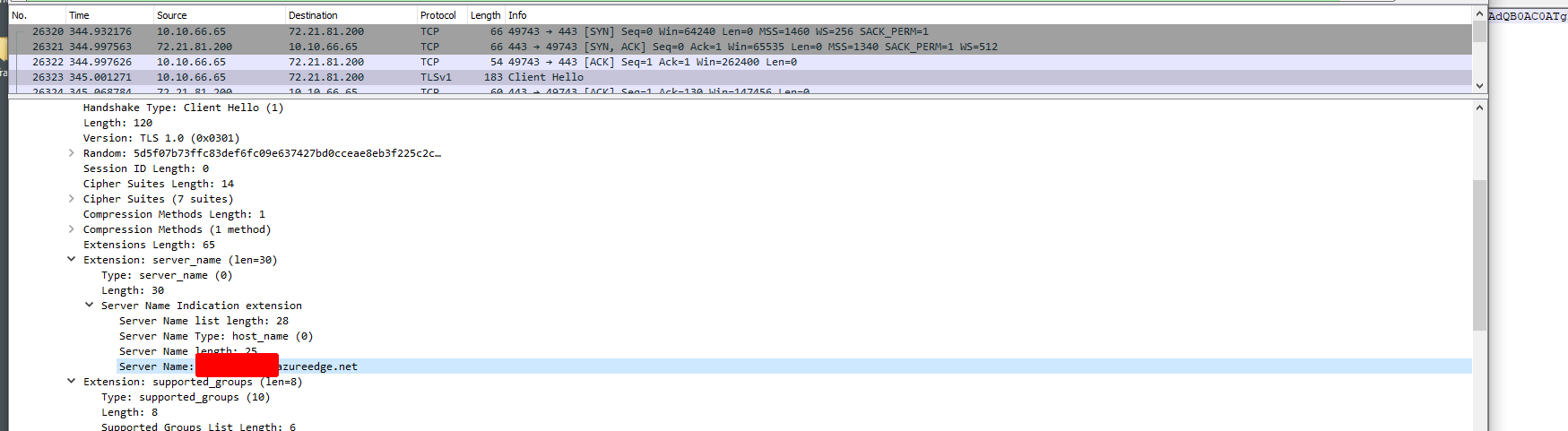
Thanks again and great work on this !
@rotarydrone Hmmm interesting, are you using a .NET Framework 3.5 payload or .NET Framework 4.0 payload?
@cobbr I ran into the same issue as @rotarydrone recently. After digging in some more, it seems like this behavior is documented here: https://github.com/dotnet/runtime/issues/20876
In essence, it appears that the default behavior of the HTTP stack (SocketsHttpHandler) is to automagically set the SNI to the "Host:" request header value, if present, and use that in the TLS/SSL handshake.
Further details here: https://azure.github.io/AppService/2018/05/02/Breaking-change-for-SNI-SSL-hostnames-on-Azure-App-Service.html. Key part: "Note that when using HttpWebRequest/HttpClient class to make SSL requests, SNI header is automatically added."
Someone else seems to have looked into it here and (unsuccessfully) tried a workaround: https://stackoverflow.com/questions/54186478/modifying-tls-sni-with-httpclient-or-httpwebrequest
In summary, it looks like the root cause is the default behavior of the .NET Core, which sends the SNI in cleartext as part of the Hello handshake. We need a way to manually set the SNI to something else.
