
grapt
 grapt copied to clipboard
 apg
apg
simple charting tools for unix.
grapt - a simple way to make graphs in unix pipelines
Summary
grapt is a set of tools that allow you to easily visualize data from a
simple, easy to produce format. It was developed out of frustration when
I realized that getting the shape of data requires a lot of extra work.
grapt isn't and will never be a fully featured graphing package.
See gnuplot if you have those needs. It will
however give you just enough insight into your data, and can easily be
invoked at the end of a shell pipeline that produces a bunch of numbers.
Installation
You'll need libcairo, make, and a C compiler. Then:
$ make
Should get you an executable named grapt. Once you have that, copy it
into a place that is configured in your $PATH.
Usage
$ grapt -h
usage: ./grapt [options]

  -H, --height=HEIGHT   Height of canvas
  -w, --width=WIDTH     Width of canvas
  -h, --help            This message
  -l, --log=BASE        Log-Y scale (w/ base, or 'e')
  -o, --output=FILENAME Output filename (defaults output.png)
  -s, --smooth=WINDOW   Smoothing window
  -t, --tee             Tee input to stdout
  -v, --version         Version information
Examples
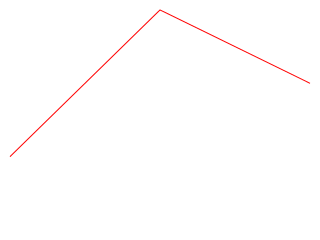
Basic usage: Graph (0, 1), (0, 3), (0, 2)
$ grapt
1
3
2
^D
This should produce a PNG file called output.png, which gives you a basic 2 line segment plot.
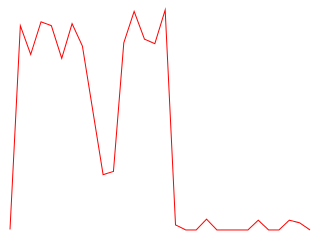
Advanced usage: IOPS for 30 seconds on sda
$ iostat 1 30 | grep 'sda' | awk '{print $2}' | grapt -o iops.png
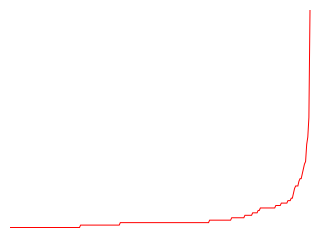
Advanced usage: token / word distribution in the grapt source code.
for n in `cat *.[ch] | sed -e 's/[^0-9a-zA-Z_]/ /g'`; do
   echo $n;
done | sort | uniq -c | sort -n | awk '{print $1}' \
| grapt -w 320 -H 240 -o word-dist.png
This gives you the word distribution from the source code, which at the time of this writing was:
Advanced usage: Distribution of random numbers with smoothing
for n in {0..10000}; do
   echo $(( $RANDOM % 100 ));
done | sort -n | uniq -c | awk '{print $1}' \
| ./grapt -w 320 -H 240 -o random.png -s 21
This gives us 2 series on the plot. The first, in bright red, shows the distribution of random numbers. The second one, in maroon, shows us a smoothed version of the red series, using a simple moving average smoothing algorithm, with a window size of 21.

Contributing and Feedback
If you'd like to fix or contribute something, please fork and submit a pull request, or open an issue. There's lots of room for improvement, and much more work to be done.
Authors
- Andrew Gwozdziewycz [email protected]
- Scott Vokes [email protected]
Copyright
Copyright 2014, Andrew Gwozdziewycz, [email protected]
Licensed under the GNU GPLv3. See LICENSE for more details
 apg
apg