

 YuLab-SMU
Weird Rarecurve
library(MicrobiotaProcess) library(ggplot2) library(phyloseq) rm(list=ls()) options(stringsAsFactors = F) setwd("C:/Users/lishu/Desktop/ARG/stin/3.1.1/") getwd() otu <- read.delim('稀释.type.txt', row.names = 1, sep = '\t', stringsAsFactors = FALSE, check.names = FALSE) otu1<-as.data.frame(otu) otu1 <- t(otu1) sd <- read.delim('.type.txt', row.names = 1,sep = '\t', stringsAsFactors = FALSE, check.names = FALSE) sd1<-as.data.frame(sd) otu1[is.na(otu1)]<-0 otu1<-ceiling(otu1) sample_data(sd) test_otu_data2<-phyloseq(otu_table(otu1,taxa_are_rows =T), sample_data(sd)) set.seed(1000) p1 <- ggrarecurve(test_otu_data2, indexNames=c("Chao1","ACE"), chunks=10) + guides(color=guide_legend(keywidth=0.5, keyheight=0.5))+ theme(legend.spacing.y=unit(0.02,"cm"), legend.text=element_text(size=6)) p1 and my rarecurve is upside down.


Hello, which version MicrobiotaProcess are you using? The MicrobiotaProcess has been updated. I recommend using the mp_cal_rarecurve and mp_plot_rarecurve to perform the analysis. You can use as.MPSE to convert the phyloseq to MPSE class, then refer to the following codes to perform it. and you can refer to the issue.
> library(MicrobiotaProcess)
MicrobiotaProcess v1.9.1.990 For help:
https://github.com/YuLab-SMU/MicrobiotaProcess/issues

If you use MicrobiotaProcess in published research, please cite the
paper:

S Xu, L Zhan, W Tang, Z Dai, L Zhou, T Feng, M Chen, S Liu, X Fu, T Wu,
E Hu, G Yu. MicrobiotaProcess: A comprehensive R package for managing
and analyzing microbiome and other ecological data within the tidy
framework. 04 February 2022, PREPRINT (Version 1) available at Research
Square [https://doi.org/10.21203/rs.3.rs-1284357/v1]

This message can be suppressed by:
suppressPackageStartupMessages(library(MicrobiotaProcess))
> data(mouse.time.mpse)
> mouse.time.mpse
# A MPSE-tibble (MPSE object) abstraction: 4,142 × 11
# OTU=218 | Samples=19 | Assays=Abundance | Taxonomy=Kingdom, Phylum, Class, Order, Family, Genus, Species
   OTU    Sample Abundance time  Kingdom Phylum Class Order Family Genus Species
   <chr>  <chr>      <int> <chr> <chr>   <chr>  <chr> <chr> <chr>  <chr> <chr>
 1 OTU_1  F3D0         579 Early k__Bac… p__Ba… c__B… o__B… f__Mu… g__u… s__un_…
 2 OTU_2  F3D0         345 Early k__Bac… p__Ba… c__B… o__B… f__Mu… g__u… s__un_…
 3 OTU_3  F3D0         449 Early k__Bac… p__Ba… c__B… o__B… f__Mu… g__u… s__un_…
 4 OTU_4  F3D0         430 Early k__Bac… p__Ba… c__B… o__B… f__Mu… g__u… s__un_…
 5 OTU_5  F3D0         154 Early k__Bac… p__Ba… c__B… o__B… f__Ba… g__B… s__un_…
 6 OTU_6  F3D0         470 Early k__Bac… p__Ba… c__B… o__B… f__Mu… g__u… s__un_…
 7 OTU_7  F3D0         282 Early k__Bac… p__Ba… c__B… o__B… f__Mu… g__u… s__un_…
 8 OTU_8  F3D0         184 Early k__Bac… p__Ba… c__B… o__B… f__Ri… g__A… s__un_…
 9 OTU_9  F3D0          45 Early k__Bac… p__Ba… c__B… o__B… f__Mu… g__u… s__un_…
10 OTU_10 F3D0         158 Early k__Bac… p__Ba… c__B… o__B… f__Mu… g__u… s__un_…
# … with 4,132 more rows
> mouse.time.mpse %<>% mp_rrarefy() %>% mp_cal_rarecurve(.abundance=RareAbundance, chunks=400)
> mouse.time.mpse %>% mp_extract_sample
# A tibble: 19 × 3
   Sample time  RareAbundanceRarecurve
   <chr>  <chr> <list>
 1 F3D0   Early <tibble [2,520 × 4]>
 2 F3D1   Early <tibble [2,520 × 4]>
 3 F3D141 Late  <tibble [2,520 × 4]>
 4 F3D142 Late  <tibble [2,520 × 4]>
 5 F3D143 Late  <tibble [2,520 × 4]>
 6 F3D144 Late  <tibble [2,520 × 4]>
 7 F3D145 Late  <tibble [2,520 × 4]>
 8 F3D146 Late  <tibble [2,520 × 4]>
 9 F3D147 Late  <tibble [2,520 × 4]>
10 F3D148 Late  <tibble [2,520 × 4]>
11 F3D149 Late  <tibble [2,520 × 4]>
12 F3D150 Late  <tibble [2,520 × 4]>
13 F3D2   Early <tibble [2,520 × 4]>
14 F3D3   Early <tibble [2,520 × 4]>
15 F3D5   Early <tibble [2,520 × 4]>
16 F3D6   Early <tibble [2,520 × 4]>
17 F3D7   Early <tibble [2,520 × 4]>
18 F3D8   Early <tibble [2,520 × 4]>
19 F3D9   Early <tibble [2,520 × 4]>
> mouse.time.mpse %>% mp_plot_rarecurve(.rare=RareAbundanceRarecurve,se=F) -> p1
> p1
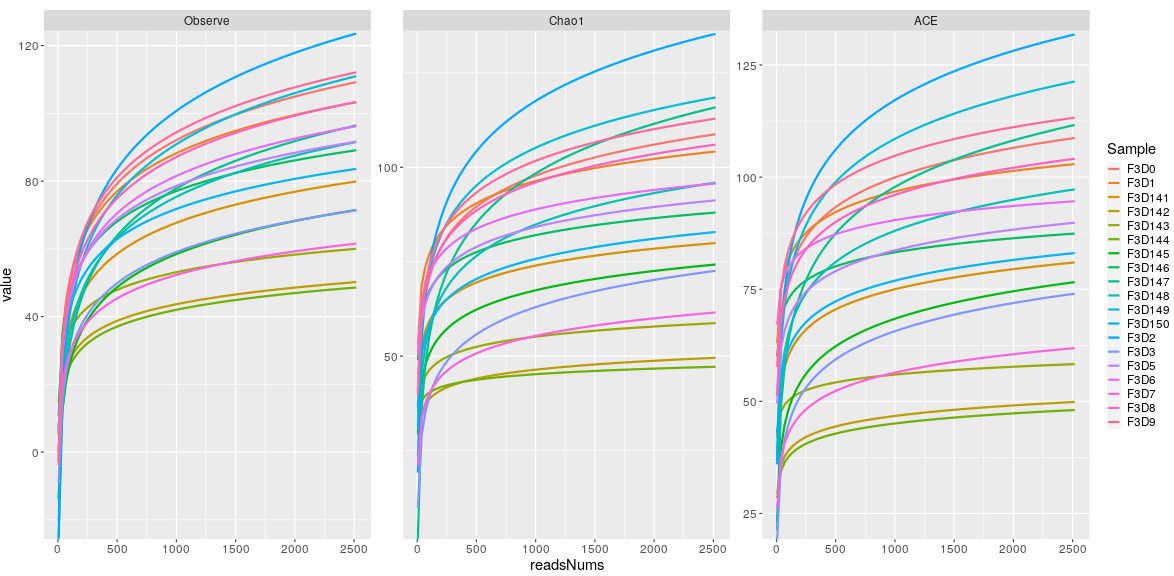
In addition, I can not reproduce the issue, would you mind uploading the data set?
you can use saveRDS(your_phyloseq, 'obj.ps') to save the phyloseq object.
