
LRFinder
 LRFinder copied to clipboard
 WittmannF
Learning Rate Finder (or LRFinder) Callback for Keras. Implementation as close as possible of FastAI.
LRFinder for Keras
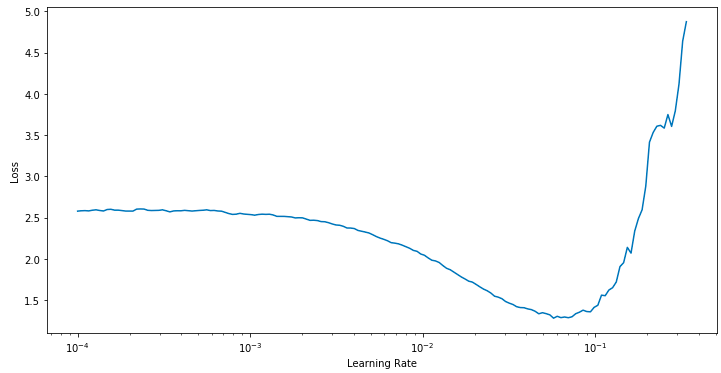
Learning Rate Finder Callback for Keras. Proposed by Leslie Smith's at https://arxiv.org/abs/1506.01186. Popularized and encouraged by Jeremy Howard in the fast.ai deep learning course.
Usage
from keras.models import Sequential
from keras.layers import Flatten, Dense
from keras.datasets import fashion_mnist
!git clone https://github.com/WittmannF/LRFinder.git
from LRFinder.keras_callback import LRFinder

# 1. Input Data
(X_train, y_train), (X_test, y_test) = fashion_mnist.load_data()

mean, std = X_train.mean(), X_train.std()
X_train, X_test = (X_train-mean)/std, (X_test-mean)/std

# 2. Define and Compile Model
model = Sequential([Flatten(),
                    Dense(512, activation='relu'),
                    Dense(10, activation='softmax')])

model.compile(loss='sparse_categorical_crossentropy', \
              metrics=['accuracy'], optimizer='sgd')


# 3. Fit using Callback
lr_finder = LRFinder(min_lr=1e-4, max_lr=1)

model.fit(X_train, y_train, batch_size=128, callbacks=[lr_finder], epochs=2)
Last Updates
- Reload weights when training ends
- Autoreload model's weights for each change of learning rate
- For each learning rate, trains the model over
batches_lr_updatebatches - Compatible with both model.fit_generator and model.fit method
- Allow usage of more than one epoch
- Included momentum to make loss function smoother
- Number of iterations is automatically inferred as the number of batches (i.e., it will always run over a full epoch)
- Set of learning rates are spaced evenly on a log scale (a geometric progression) using np.geospace
- Automatic stop criteria if
current_loss > stop_multiplier * lowest_loss stop_multiplieris a linear equation where it is 10 if momentum is 0 and 4 if momentum is 0.9
Next Updates
- Use exponential annealing instead of np.geospace (
start * (end/start) ** pct) - Add a test framework
License
- MIT
 WittmannF