

 PyCQA
PyCQA
try-else clauses measured at 1 more than correct complexity
Currently the below code generates the following graph, giving a complexity of 5:
def f():
    try:
        print(1)
    except TypeA:
        print(2)
    except TypeB:
        print(3)
    else:
        print(4)
    finally:
        if x:
            print(5.1)
        else:
            print(5.2)

I don't think this models the try-else clause correctly. The above graph seems to indicate that the else sometimes runs instead of the main clause, which isn't correct. I believe this is the correct model:

This seems to correctly indicate that the else always runs directly after the main try clause, if it runs, and never in a line of execution that involves the exception handlers. This has 1 less complexity than the above graph. This yields one less complexity than the current interpretation.

Sorry for the confusion on #26. I agree that this is the right graph (with the exception of where the edges from the try body start for the except clauses.
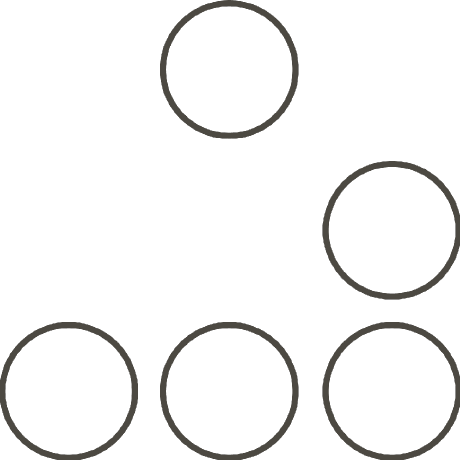
Should we get more buy-in before I submit a patch? The quick hack I put in to make that diagram is pretty ugly.
Note that this problem is not at all restricted to try-except constructs with an else clause. Where there is no 'else' the graph simply contains an edge going directly from the 'try' statement to the end of the block without passing through either the body of the try or any of the exception handlers.
This is a regression in 0.3 (and all later versions) - 0.2.1 generates the correct graph. I suspect but have not bothered to verify that this is due to https://github.com/PyCQA/mccabe/commit/0a42f06c8f32b63e3ef7f55bdfcd23aca16c0b65
i.e. this function:
def test_try(s):
    try:
        return int(s)
    except TypeError:
        return -1
returns a cyclomatic complexity of 3 instead of 2 (consistent with 0.2.1, but only because of the off-by-one error #5 that was fixed); and this function:
def test_try2(s1, s2):
    try:
        i1 = int(s1)
    except TypeError:
        i1 = -1
    try:
        i2 = int(s2)
    except TypeError:
        i2 = -1
    return i1, i2
returns a cyclomatic complexity of 5 instead of 3 (vs. 4 in 0.2.1 due to the aforementioned off-by-one error fix.)
Ergo functions whose complexity is dominated by try/except have values that are off by up to a factor of 2.
