

 OpenFAST
Non-circular Morison Elements
Is your feature request related to a problem? Please describe. (I wasn`t sure whether I should open a PR or an issue to discuss this topic, so I apologize if this is not the correct approach)
If I am not mistaken, currently OpenFAST includes only circular Morison elements (whether tapered or not), so I made some modifications to the source code to be able to model elements with rectangular section in order to analyze a FOWT with pontoons. I needed this change because drag is a very relevant forcing component in heave for a hull that my research group is currently working on (about which, unfortunately, I am not allowed to share details yet), but the drag coefficients required to reproduce the heave motion measured in our experiments led to an overestimation of damping levels for the horizontal motions. In other words, if I adopt a diameter (which would be different in the horizontal and vertical directions) and tune the drag coefficient of the pontoons to match heave decay tests, I have pretty good heave results, but bad surge/sway/yaw around their resonance frequencies; conversely, if I match surge decay tests, I get good results in surge/sway/yaw, but a less than adequate heave prediction. This is illustrated below.
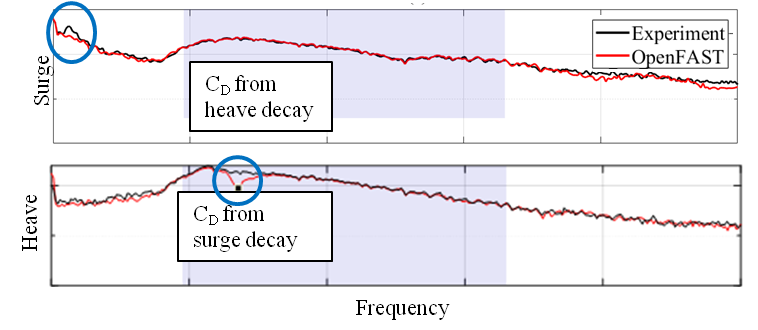
Describe the solution you'd like In order to reduce the number of changes in the input file, the solution that I adopted was to use an unidirectional Morison element. More specifically, the loads along the element are always projected into the same direction perpendicular to the axis of the Morison element, which is determined by a third joint that is specified for each member, and not along the direction of the instantaneous perpendicular velocity vector. Hence, the rectangular pontoon can be modeled by the superposition of two unidirectional elements, and only one additional field is required in the input files. I focused on situations where the floater is modeled using diffraction theory and Morison element are used only for drag (PropPot = TRUE), and I don't know exactly how to extend this approach to situations where the potential part is also modeled using Morison elements, specially concerning buoyancy.
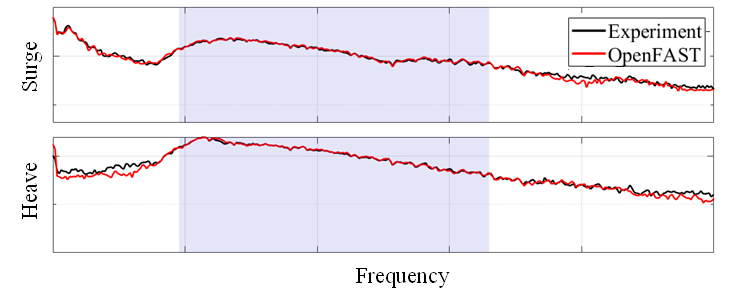
Perhaps this approach is somewhat hackish, but it solved my specific problem quite well, so I was wondering whether you would be interested in incorporating that into OpenFAST. Below is an illustration of the results after the modification.
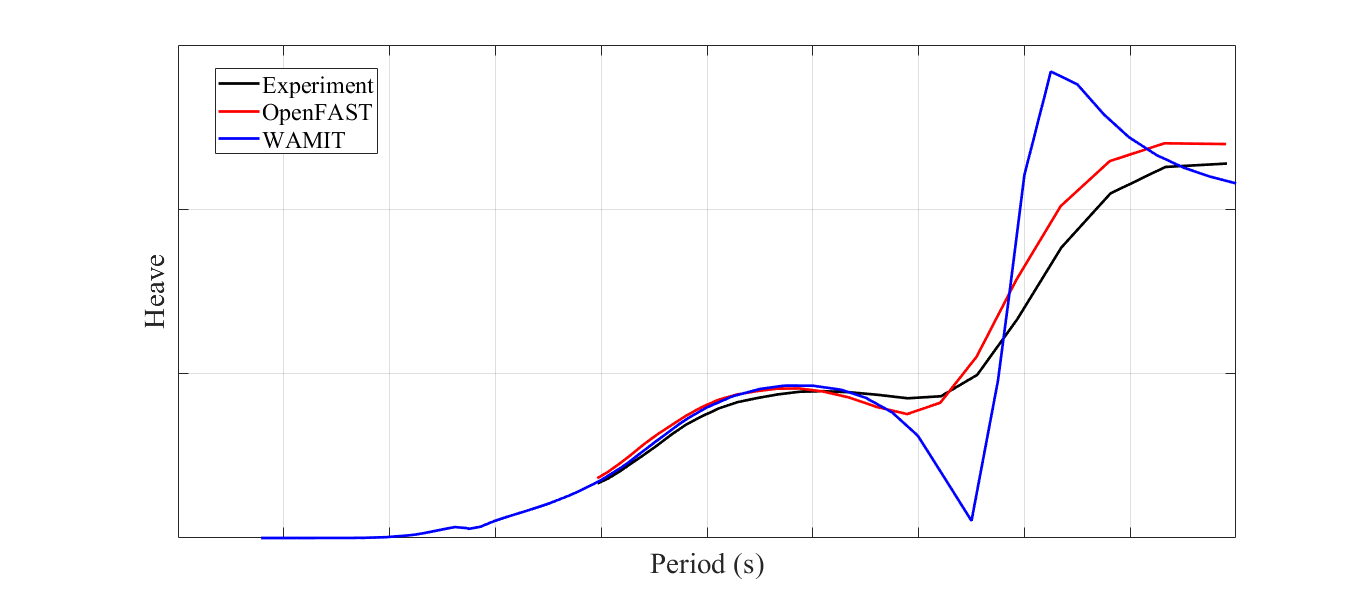
The figure below, which compares the heave RAO obtained by the experiment, OpenFAST and WAMIT, shows that the problem in the vertical direction was not due to damping, which would be easily solved by adding an additional quadratic drag (AddBQuad), but indeed due to drag forcing. The minimum heave motion presented by WAMIT corresponds to the frequencies highlighted in the first figure provided above.
Describe alternatives you've considered Some codes have rectangular Morison elements to deal with that kind of situation, but I think that this would require more complex modifications to the current input file.
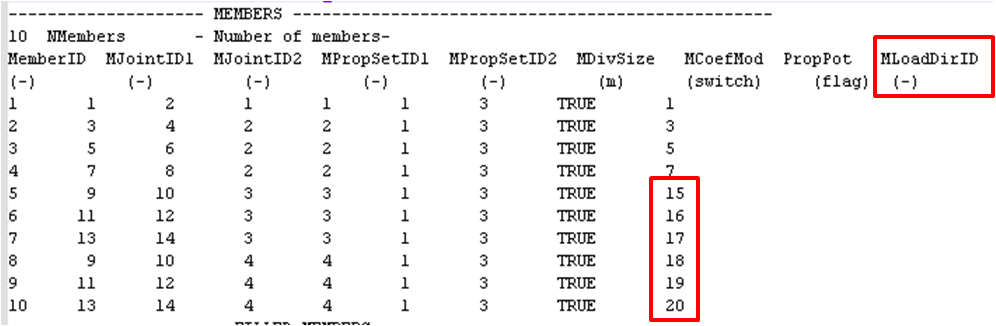
Additional context The modification in the input file is illustrated below. It is an additional column with the ID of a joint, which I called MLoadDirID, specified previously in the joints table. Note that the first four elements have a MLoadDirID that is the same as MJointID1, which is the way that I found to specify that these elements should behave as a circular Morison element (i.e. like before the modification).

Dear @Lucas-Carmo,
It sounds like you've implemented a workaround to the limitation in HydroDyn that the strip-theory (Morison) members must have a circular cross for application to cross sections that are actually rectangular. I agree with the need to support rectangular cross sections in the strip-theory solution in HydroDyn, as well as in the beam solution in SubDyn. I agree that your approach is a bit "hackish", but it I'm glad it solves your immediate need. Another "hackish" approach we've used, which doesn't require any source code change, is to introduce horizontal or vertical heave plates into HydroDyn to allow one direction to have different hydrodynamic coefficients than another. (Heave plates can be added by placing two joints very closely spaced together such that the volume and transverse area of the member connecting the two joints is small, but the axial area is large, and using this area and the associated axial coefficients to obtain the desired hydrodynamic properties.)
Longer term, it is our desire at NREL to implement a more direct (but more complex), less "hackish", way of implementing rectangular cross sections in both the strip-theory solution of HydroDyn and the beam solution in SubDyn.
Best regards,

Dear @jjonkman
These additional heave plates would indeed have solved my problem! Guess I should have asked about a workaround before trying to find my own :sweat_smile: In any case, it was a nice way to learn more about the source code.
But great to know that this improvement is on your radar! I look forward to its implementation.
Best regards,