

 OAID
OAID
输入图片尺寸高h和宽w不相等时报错Segmentation Fault
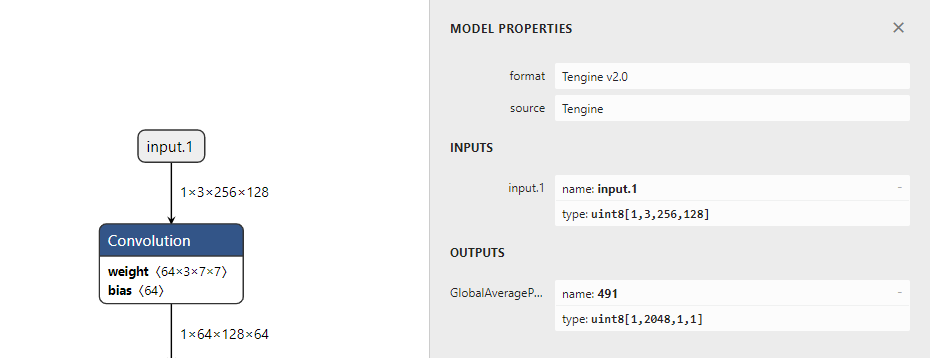
pytorch导出预训练resnet50模型,去掉fc层,输入设置为256x128,经过量化成uint8模型以后,发现在tm_classification_timvx基础上小修改后,-g 256,128时会出现Segmentation Fault,但是-g 256,256或者-g 128,128 却是能正常运行的,明明模型的输入设置是256x128,为什么经过resize的图片大小和模型设置不一致时能正常输出结果,一致的时候却会报错呢orz,下面是我的测试代码以及onnx和uint8模型,目前能够确认是在run_graph函数这里出错了
测试环境是khadas vim3 最新的npu驱动



链接:https://pan.baidu.com/s/1vnkseiQ3EeWeiXpwKfevRA 提取码:lq14 --来自百度网盘超级会员V4的分享
/*
 * Licensed to the Apache Software Foundation (ASF) under one
 * or more contributor license agreements.  See the NOTICE file
 * distributed with this work for additional information
 * regarding copyright ownership.  The ASF licenses this file
 * to you under the Apache License, Version 2.0 (the
 * License); you may not use this file except in compliance
 * with the License.  You may obtain a copy of the License at
 *
 *   http://www.apache.org/licenses/LICENSE-2.0
 *
 * Unless required by applicable law or agreed to in writing,
 * software distributed under the License is distributed on an
 * AS IS BASIS, WITHOUT WARRANTIES OR CONDITIONS OF ANY
 * KIND, either express or implied.  See the License for the
 * specific language governing permissions and limitations
 * under the License.
 */

/*
 * Copyright (c) 2020, OPEN AI LAB
 * Author: [email protected]
 */

#include <stdlib.h>
#include <stdio.h>

#include "common.h"
#include "tengine/c_api.h"
#include "tengine_operations.h"

#define DEFAULT_IMG_H        256
#define DEFAULT_IMG_W        128
#define DEFAULT_SCALE1       0.0174
#define DEFAULT_SCALE2       0.0175
#define DEFAULT_SCALE3       0.0171
#define DEFAULT_MEAN1        103.53
#define DEFAULT_MEAN2        116.28
#define DEFAULT_MEAN3        123.675
#define DEFAULT_LOOP_COUNT   1
#define DEFAULT_THREAD_COUNT 1
#define DEFAULT_CPU_AFFINITY 255

void get_input_uint8_data(const char* image_file, uint8_t* input_data, int img_h, int img_w, float* mean, float* scale,
                          float input_scale, int zero_point)
{
    image img = imread_process(image_file, img_w, img_h, mean, scale);

    float* image_data = (float*)img.data;
    for (int i = 0; i < img_w * img_h * 3; i++)
    {
        int udata = round(image_data[i] / input_scale + (float)zero_point);
        if (udata > 255)
            udata = 255;
        else if (udata < 0)
            udata = 0;

        input_data[i] = udata;
    }

    free_image(img);
}

int tengine_reid(const char* model_file, const char* image_file, int img_h, int img_w, float* mean, float* scale,
                     int loop_count, int num_thread, int affinity)
{
    /* set runtime options */
    struct options opt;
    opt.num_thread = num_thread;
    opt.cluster = TENGINE_CLUSTER_ALL;
    opt.precision = TENGINE_MODE_UINT8;
    opt.affinity = affinity;

    /* inital tengine */
    if (init_tengine() != 0)
    {
        fprintf(stderr, "Initial tengine failed.\n");
        return -1;
    }
    fprintf(stderr, "tengine-lite library version: %s\n", get_tengine_version());

    /* create VeriSilicon TIM-VX backend */
    context_t timvx_context = create_context("timvx", 1);
    int rtt = set_context_device(timvx_context, "TIMVX", NULL, 0);
    if (0 > rtt)
    {
        fprintf(stderr, " add_context_device VSI DEVICE failed.\n");
        return -1;
    }

    /* create graph, load tengine model xxx.tmfile */
    graph_t graph = create_graph(timvx_context, "tengine", model_file);
    if (NULL == graph)
    {
        fprintf(stderr, "Create graph failed.\n");
        return -1;
    }

    /* set the input shape to initial the graph, and prerun graph to infer shape */
    int img_size = img_h * img_w * 3;
    int dims[] = {1, 3, img_h, img_w}; // nchw
    uint8_t* input_data = (uint8_t*)malloc(img_size);

    tensor_t input_tensor = get_graph_input_tensor(graph, 0, 0);
    if (input_tensor == NULL)
    {
        fprintf(stderr, "Get input tensor failed\n");
        return -1;
    }

    if (set_tensor_shape(input_tensor, dims, 4) < 0)
    {
        fprintf(stderr, "Set input tensor shape failed\n");
        return -1;
    }

    if (set_tensor_buffer(input_tensor, input_data, img_size) < 0)
    {
        fprintf(stderr, "Set input tensor buffer failed\n");
        return -1;
    }

    /* prerun graph, set work options(num_thread, cluster, precision) */
    if (prerun_graph_multithread(graph, opt) < 0)
    {
        fprintf(stderr, "Prerun multithread graph failed.\n");
        return -1;
    }

    /* prepare process input data, set the data mem to input tensor */
    float input_scale = 0.f;
    int input_zero_point = 0;
    get_tensor_quant_param(input_tensor, &input_scale, &input_zero_point, 1);
    get_input_uint8_data(image_file, input_data, img_h, img_w, mean, scale, input_scale, input_zero_point);

    /* run graph */
    double min_time = DBL_MAX;
    double max_time = DBL_MIN;
    double total_time = 0.;
    for (int i = 0; i < loop_count; i++)
    {
        double start = get_current_time();
        if (run_graph(graph, 1) < 0)
        {
            fprintf(stderr, "Run graph failed\n");
            return -1;
        }
        double end = get_current_time();
        double cur = end - start;
        total_time += cur;
        if (min_time > cur)
            min_time = cur;
        if (max_time < cur)
            max_time = cur;
    }
    fprintf(stderr, "\nmodel file : %s\n", model_file);
    fprintf(stderr, "image file : %s\n", image_file);
    fprintf(stderr, "img_h, img_w, scale[3], mean[3] : %d %d , %.3f %.3f %.3f, %.1f %.1f %.1f\n", img_h, img_w,
            scale[0], scale[1], scale[2], mean[0], mean[1], mean[2]);
    fprintf(stderr, "Repeat %d times, thread %d, avg time %.2f ms, max_time %.2f ms, min_time %.2f ms\n", loop_count,
            num_thread, total_time / loop_count, max_time, min_time);
    fprintf(stderr, "--------------------------------------\n");

    /* get the result of classification */
    tensor_t output_tensor = get_graph_output_tensor(graph, 0, 0);
    uint8_t* output_u8 = (uint8_t*)get_tensor_buffer(output_tensor);
    int output_size = get_tensor_buffer_size(output_tensor);

    /* dequant */
    float output_scale = 0.f;
    int output_zero_point = 0;
    get_tensor_quant_param(output_tensor, &output_scale, &output_zero_point, 1);
    float* output_data = (float*)malloc(output_size * sizeof(float));
    for (int i = 0; i < output_size; i++)
    {
        output_data[i] = ((float)output_u8[i] - (float)output_zero_point) * output_scale;
    }


    // print_topk(output_data, output_size, 5);
    // fprintf(stderr, "--------------------------------------\n");

    /* release tengine */
    free(input_data);
    free(output_data);
    postrun_graph(graph);
    destroy_graph(graph);
    release_tengine();

    return 0;
}

void show_usage()
{
    fprintf(
        stderr,
        "[Usage]:  [-h]\n    [-m model_file] [-i image_file]\n [-g img_h,img_w] [-s scale[0],scale[1],scale[2]] [-w "
        "mean[0],mean[1],mean[2]] [-r loop_count] [-t thread_count] [-a cpu_affinity]\n");
    fprintf(
        stderr,
        "\nmobilenet example: \n    ./classification -m /path/to/mobilenet.tmfile -i /path/to/img.jpg -g 224,224 -s "
        "0.017,0.017,0.017 -w 104.007,116.669,122.679\n");
}

int main(int argc, char* argv[])
{
    int loop_count = DEFAULT_LOOP_COUNT;
    int num_thread = DEFAULT_THREAD_COUNT;
    int cpu_affinity = DEFAULT_CPU_AFFINITY;
    char* model_file = NULL;
    char* image_file = NULL;
    float img_hw[2] = {0.f};
    int img_h = 0;
    int img_w = 0;
    float mean[3] = {-1.f, -1.f, -1.f};
    float scale[3] = {0.f, 0.f, 0.f};

    int res;
    while ((res = getopt(argc, argv, "m:i:l:g:s:w:r:t:a:h")) != -1)
    {
        switch (res)
        {
        case 'm':
            model_file = optarg;
            break;
        case 'i':
            image_file = optarg;
            break;
        case 'g':
            split(img_hw, optarg, ",");
            img_h = (int)img_hw[0];
            img_w = (int)img_hw[1];
            break;
        case 's':
            split(scale, optarg, ",");
            break;
        case 'w':
            split(mean, optarg, ",");
            break;
        case 'r':
            loop_count = atoi(optarg);
            break;
        case 't':
            num_thread = atoi(optarg);
            break;
        case 'a':
            cpu_affinity = atoi(optarg);
            break;
        case 'h':
            show_usage();
            return 0;
        default:
            break;
        }
    }

    /* check files */
    if (model_file == NULL)
    {
        fprintf(stderr, "Error: Tengine model file not specified!\n");
        show_usage();
        return -1;
    }

    if (image_file == NULL)
    {
        fprintf(stderr, "Error: Image file not specified!\n");
        show_usage();
        return -1;
    }

    if (!check_file_exist(model_file) || !check_file_exist(image_file))
        return -1;

    if (img_h == 0)
    {
        img_h = DEFAULT_IMG_H;
        fprintf(stderr, "Image height not specified, use default %d\n", img_h);
    }

    if (img_w == 0)
    {
        img_w = DEFAULT_IMG_W;
        fprintf(stderr, "Image width not specified, use default  %d\n", img_w);
    }

    if (scale[0] == 0.f || scale[1] == 0.f || scale[2] == 0.f)
    {
        scale[0] = DEFAULT_SCALE1;
        scale[1] = DEFAULT_SCALE2;
        scale[2] = DEFAULT_SCALE3;
        fprintf(stderr, "Scale value not specified, use default  %.4f, %.4f, %.4f\n", scale[0], scale[1], scale[2]);
    }

    if (mean[0] == -1.0 || mean[1] == -1.0 || mean[2] == -1.0)
    {
        mean[0] = DEFAULT_MEAN1;
        mean[1] = DEFAULT_MEAN2;
        mean[2] = DEFAULT_MEAN3;
        fprintf(stderr, "Mean value not specified, use default   %.1f, %.1f, %.1f\n", mean[0], mean[1], mean[2]);
    }

    if (tengine_reid(model_file, image_file, img_h, img_w, mean, scale, loop_count, num_thread, cpu_affinity) < 0)
        return -1;

    return 0;
}

我看了一下,对应示例,我个人理解,原因可能是默认尺寸是相等的,对应的tensor以及构建gragh,是根据尺寸想等的情况下处理,所以不相等时可能出现异常,而且项目没有对这个异常进行处理(依稀记得虫叔那篇文章提过输入尺寸的规则),更具体的好像要研究一下对应参数,以及run gragh流程了

@LJoson 是的,我尝试了一下khadas自家提供的sdk,它们同样调用的是TIM-VX,没有发现这个问题,应该是Tengine这边出bug了
我看了一下,对应示例,我个人理解,原因可能是默认尺寸是相等的,对应的tensor以及构建gragh,是根据尺寸想等的情况下处理,所以不相等时可能出现异常,而且项目没有对这个异常进行处理(依稀记得虫叔那篇文章提过输入尺寸的规则),更具体的好像要研究一下对应参数,以及run gragh流程了