

 GEOS-DEV
EDFM improvements - add CI computation kernel that uses numerical integration.
In this PR we are adding some improvements to the current EDFM implementation:
- [x] create a dedicated kernel for the computation of the connectivity index.
- [x] improve connectivity index (CI) computation. The CI requires the computation of the average distance which, in this PR, is computed by sampling each element and computing the average distance of all sampling points (Eq. 8 of https://www.sciencedirect.com/science/article/pii/S0021999111005080).
- [x] add MGR strategy for Poromechcnics efem-edfm (not ideal yet).
- [x] reorganize input files and add some integrated tests
- [x] removed the
discretizationNamefield from theSurfaceGenerator. It's not used and it forces us to have an meaningless attribute in the xmls.
In a future PR some functionalities related to mapping between parent and physical spaces should be moved to a different part of the code as, right now, finite element space and element shape are a bit mixed.
https://github.com/GEOSX/integratedTests/pull/251

In a future PR some functionalities related to mapping between parent and physical spaces should be moved to a different part of the code as, right now, finite element space and element shape are a bit mixed.
I agree. We don't want to specify any FE discretization in a finite volume-based simulation, e.g.:
https://github.com/GEOSX/GEOSX/blob/0c012ed23afb8910f6e073a823ef66436d49c001/inputFiles/singlePhaseFlow/fractureMatrixFlow_EDFM_base.xml#L3-L16
https://github.com/GEOSX/GEOSX/blob/0c012ed23afb8910f6e073a823ef66436d49c001/inputFiles/singlePhaseFlow/fractureMatrixFlow_EDFM_base.xml#L18-L25
https://github.com/GEOSX/GEOSX/blob/0c012ed23afb8910f6e073a823ef66436d49c001/inputFiles/singlePhaseFlow/fractureMatrixFlow_EDFM_base.xml#L62-L72
But we can address this in a follow-up PR, once the capability is in place and works as expected.

This is a singlephase case, that I am also adding as a smoke test, with a slanted fracture with hexes:
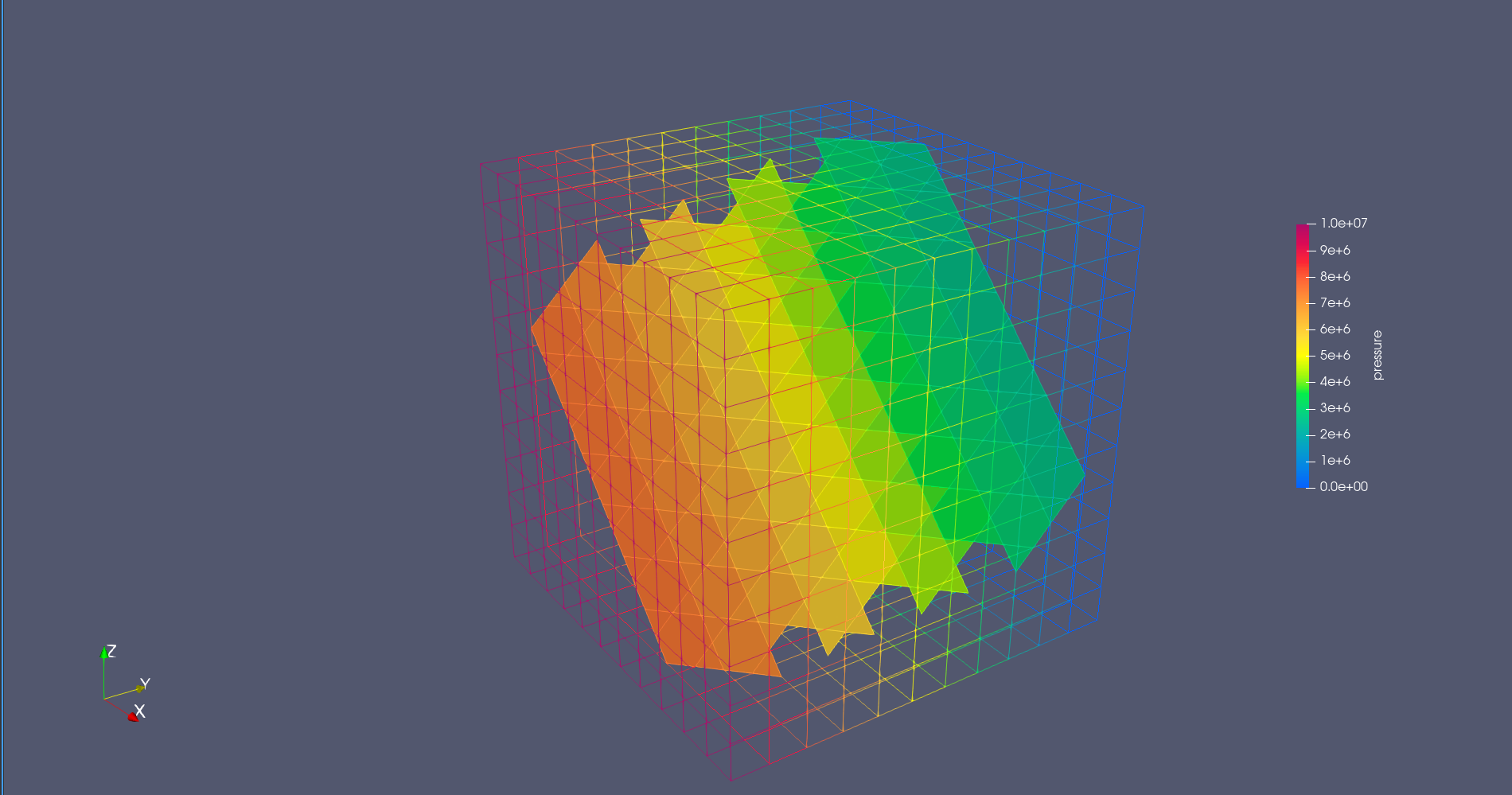
I have kept the permeability of the fracture close to the one in the matrix to be able to see the gradient of the pressure inside the fracture. It seems to be that it's behaving as expected. Unfortunately, I don't think there s any analytical solution we can use to validate this.
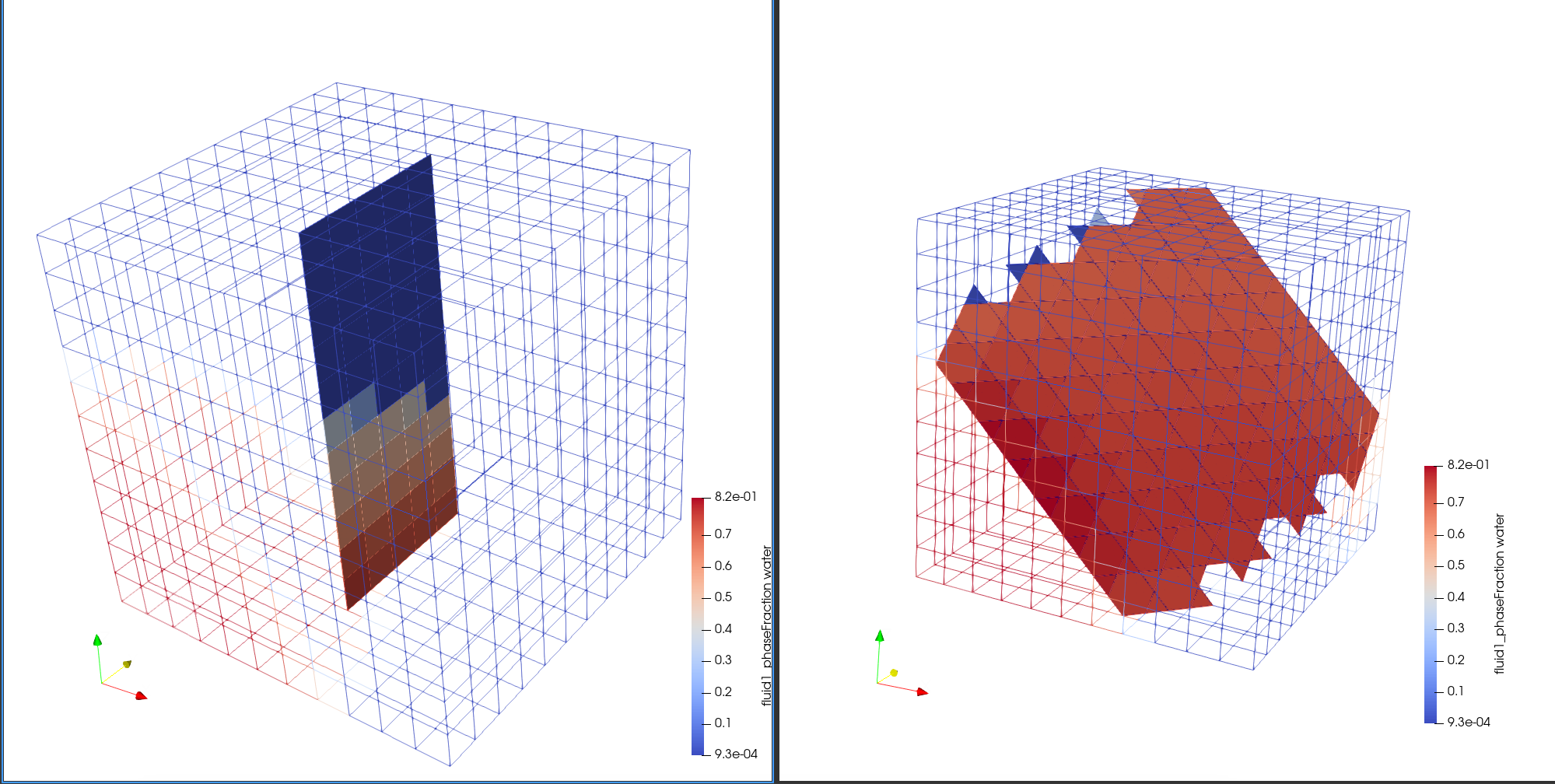
And these are an horizontal and inclined fracture cases with the compositional solver
@castelletto1, @rrsettgast, @joshua-white can someone review this PR so that I can merge it?